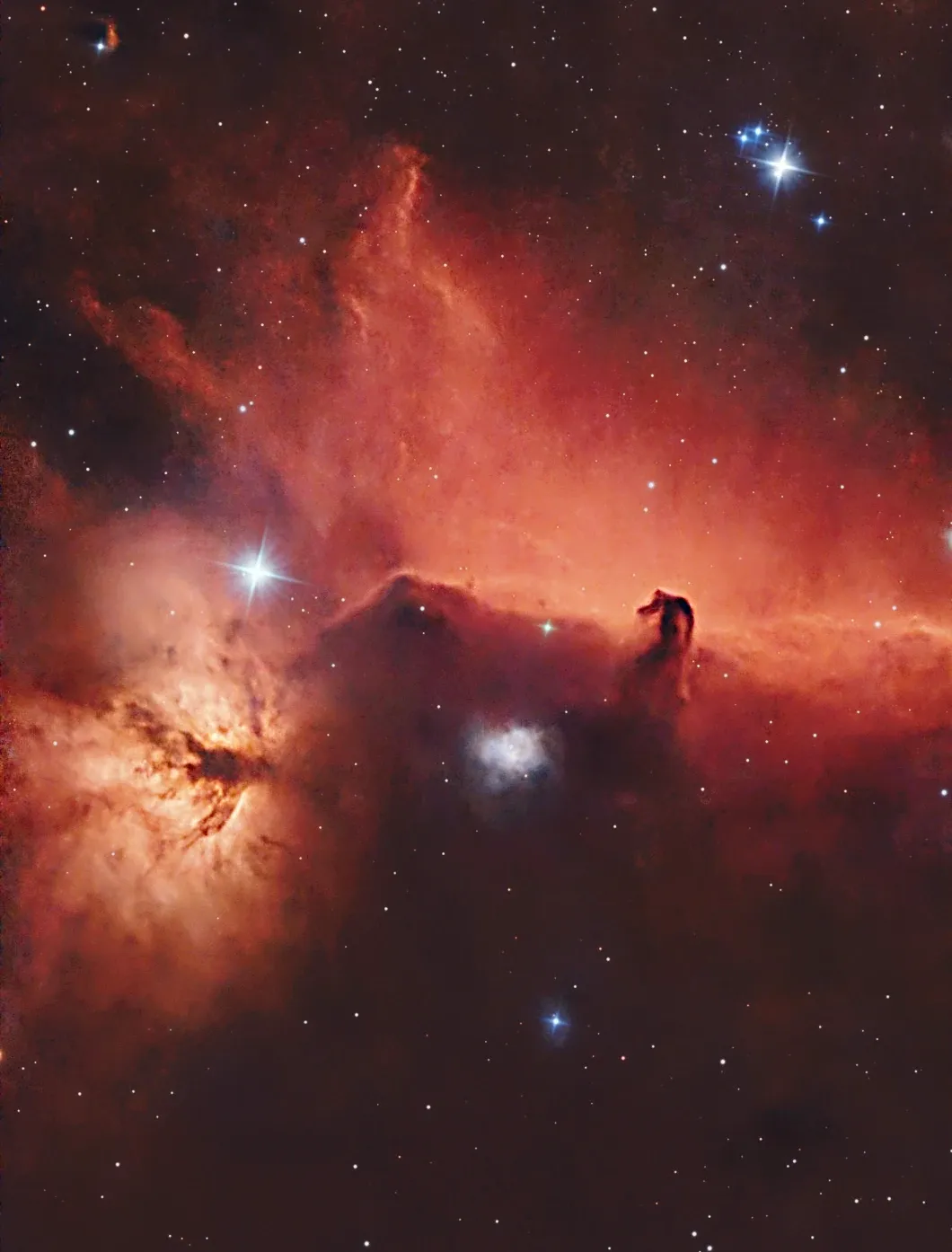
 And here’s the Dwarf Mini’s shot of the Horsehead Nebula.
A1 is rereading Dominion by CJ Sansom. A2 is reading A Memory Called Empire* by Arkady Martine.
Category: Astronomy
The Moon Was a Ghostly Galleon
 A2 is reading The Impossible Fortune by Richard Osman which is indistinguishable from all his other books.
Sight of the Night: the Northern Lights over Potternewton Heights
Here is something we don’t see very often (actually we don’t see it all, but our phones can): the Aurora Borealis.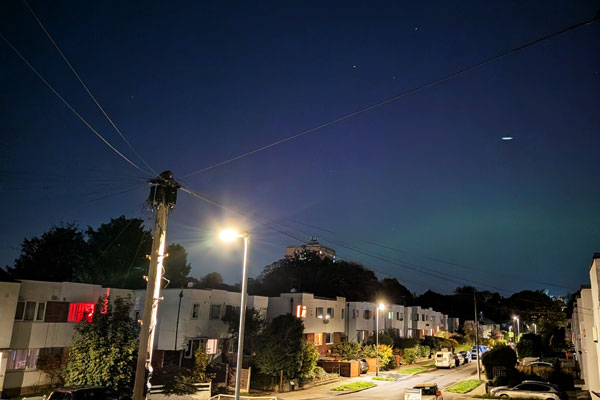 And here it is again, with a small amount of structure.
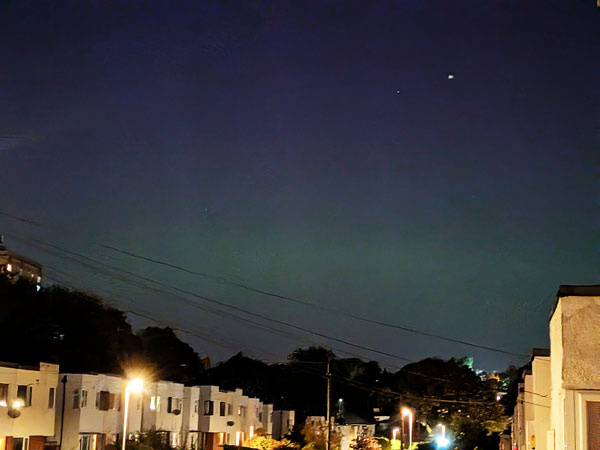 The telephone wires look messy because the wind was blowing. This display was seen throughout the UK.
And later, the Dwarf Mini had an outing to observe Mars passing through Praesepe, or the colourful Beehive Cluster, in the constellation Cancer. Mars is the brightest object here, slightly elongated due to its movement through the 1-hour exposure at 5am. The Mini isn’t powerful enough to image Mars as a disc, but it makes a pretty photo.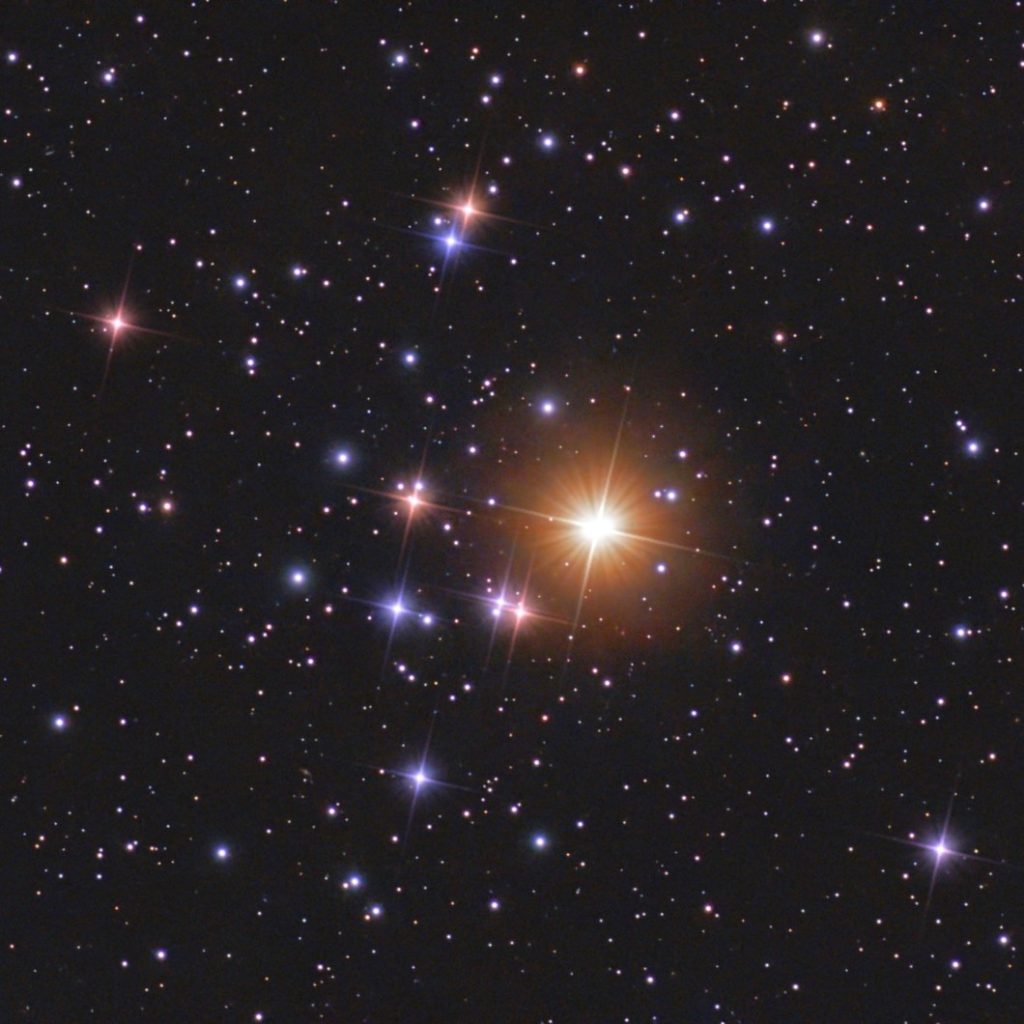
Clouds in Raindrops and a Super Supernova
 The clouds have now blown away and the Dwarf Mini is out observing a supernova in a distant galaxy.
Later: And the results are in! I first photographed this galaxy (C 30, known as the “Deer Lick group”, bizarrely) a couple of weeks back on 21 August. In early September there came news of a supernova, so on the first clearish night for ages I had another go. Clouds moved in so there there were fewer exposures this time (hence some of the fainter stars don’t appear), but the supernova — designated SN 2026aaiv — is clearly visible. A supernova is an extremely energetic explosion that happens when a star reaches the end of its life, and can briefly outshine a whole galaxy of billions of stars. Luckily this one is about 45 million light years away.
 In preparation for reading Cold Sunset by William Boyd, A2 is rereading the rest of the trilogy (so far), starting with Gabriel’s Moon. A1 is reading The Lost Women by Tim Weaver.
Misty Moon
 Here’s the Moon swaddled in a blanket of cloud. And here it is earlier; stark naked and red in the face:
 August was our third sunniest August ever but less warm and wet than the average August.
A2 is rereading Black Swan Green by David Mitchell, which featured no fewer than 5 moon-grey cats.
Crescent Sun
 The weather stayed clear for the eclipse yesterday. Here’s the traditional colander shot, awkwardly taken because it was difficult to hold a camera and a colander at the same time and there was only a tiny bit of unshadowed wall to project on:

And here’s a montage of images from the Dwarf Mini and a first stab at a video, 2 hours in 20 seconds:
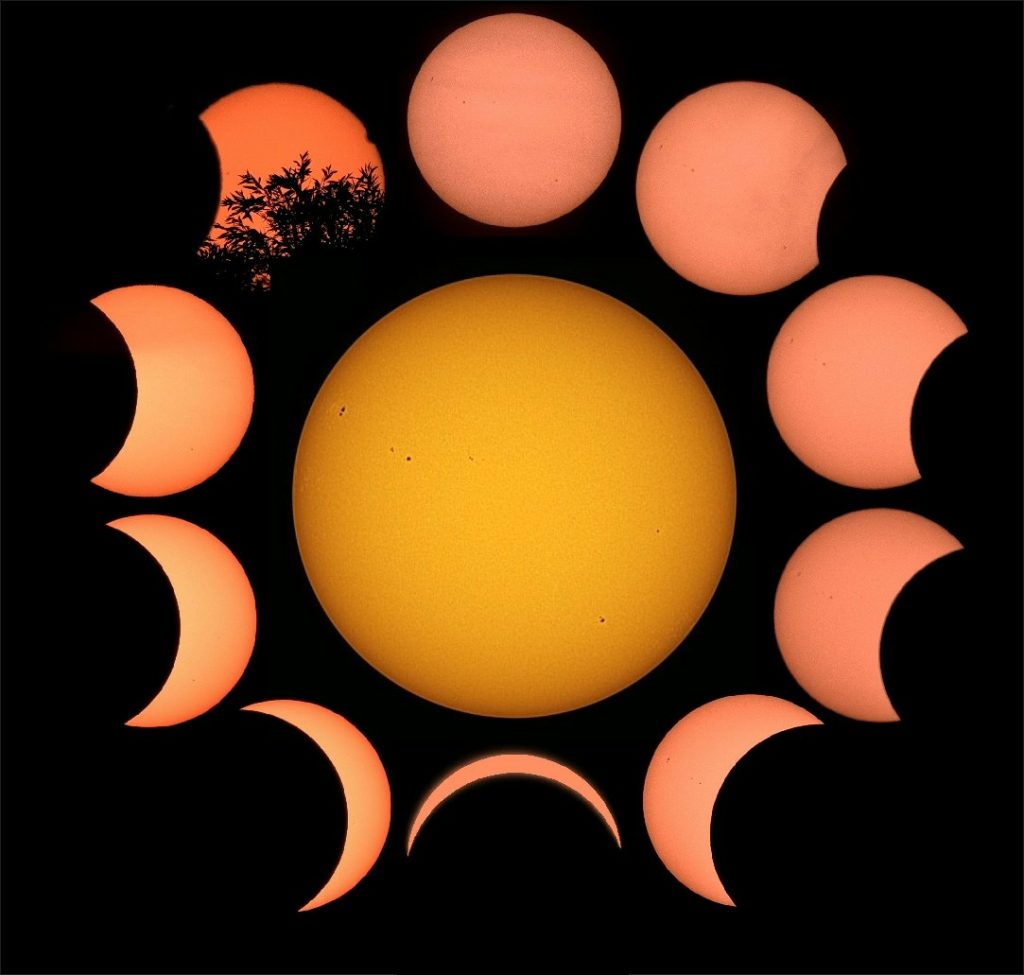
Later we watched a small selection of Perseid meteors. A great day!
And today is our warmest day of the year: 34.1°C
A1 is reading The Pinnacle by Abir Mukherjee, which had lots of horrible people being horrible to each other and swearing a lot. Disappointing — like his mate Vaseem Khan he should stick to historical crime novels.
A2’s toilet tome is Careless People by Sarah Wynn-Williams. Delete your Facebook account NOW!
ISS
While preparing for last night’s Dwarf Mini observing session (details here), A1 tried out his new phone, a Pixel 10a, on its astronomy setting. And accidentally caught the International Space Station as it flew overhead:
An Active Sun
Between 23 June and 5 July some sunspots moved across the Sun as it rotated (it takes about 25 days to rotate fully). I managed — with some difficulty! — to photograph the Sun with the Dwarf Mini every day until 3 July, when the clouds moved in. I then made this video, showing the spots as they developed and moved across the face of our star.
This isn’t perfect. The images were all taken at different times so they needed rotating to orient them correctly … which is quite hard to do with something like the Sun. Still, a first effort.
Coincidentally, these spots erupted in flares during this time, and caused massive auroras over the US on their Independence Day.
A2 is reading Quite Ugly One Evening by Chris Brookmyre.
Busy Mini
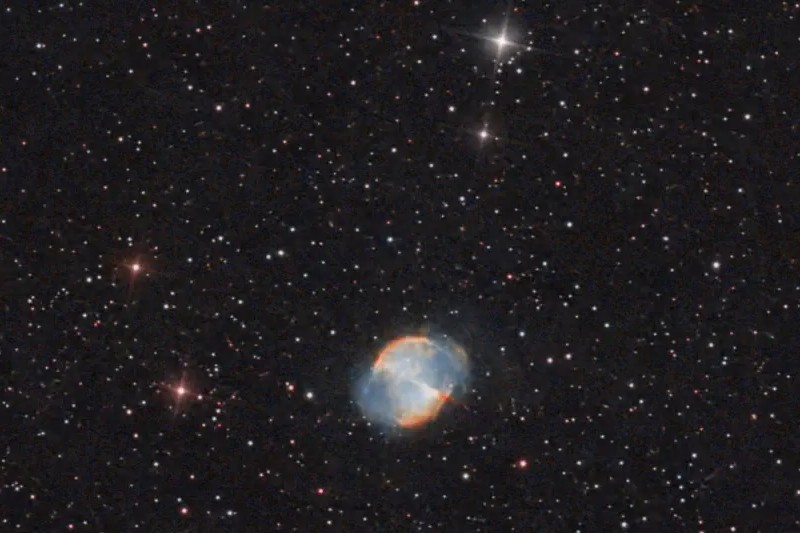
Here are a few recent pics from our Dwarf Mini telescope. This is the Dumbbell Nebula, in Vulpecula (The Fox):
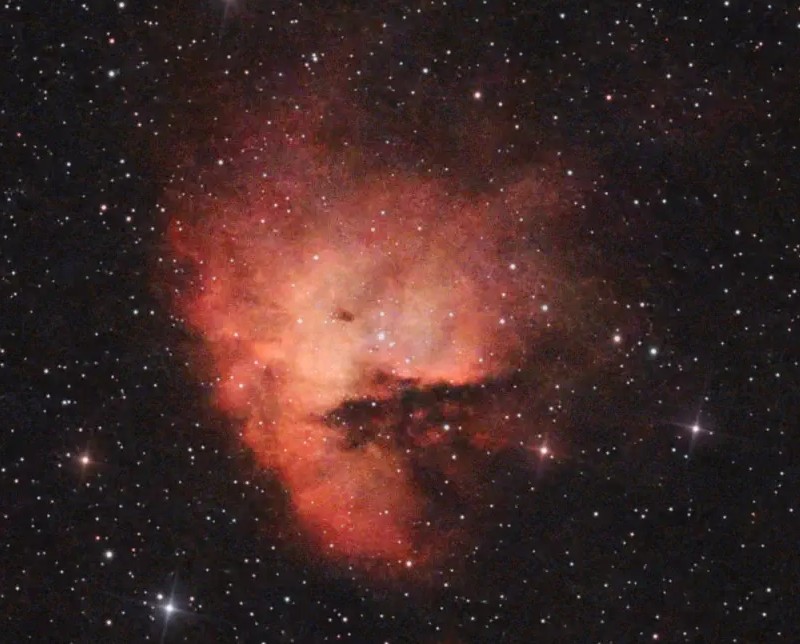
The Pac-Man Nebula, in Cassiopeia:
 And the Andromeda Galaxy in, er, Andromeda:
 Much bigger versions and more details on our ROAST blog.
A1 is reading The Ides of April by Lindsey Davis. A2 is reading Seascraper* by Benjamin Wood, a poignant and atmospheric book about a shrimp catcher which had echoes of Beryl Bainbridge. BW is on record as admiring The Dressmaker.
Spot the Spots
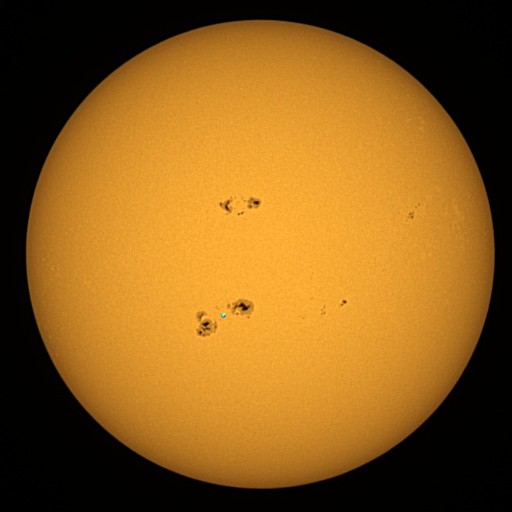
The sun has been very spotty recently, and this was taken this morning during a break in the clouds.
But what’s that greeny-blue dot between the pair of large sunspots? That’s us, that is. The Earth, roughly to scale; you can fit 109 Earths in the diameter of the Sun. Here it is zoomed in:
 A1 is reading Quite Ugly One Evening by Chris Brookmyre. Thanks A2! CB’s first published novel was Quite Ugly One Morning (1996), which introduced his journalist protagonist Jack Parlabane, and this novel continues — and possibly wraps up — Parlabane’s (rather doleful) character arc. While CB’s writing no longer provokes LOLs at his wonderful outrageousness (like the abseiling scene in Be My Enemy, or the unfortunate bodily invasion in Boiling a Frog), he continues to take aim at his bêtes noires — in this case MAGA loonies, influencers, fanboyz, right-wing fanatics with a complete disregard for morality, and rich bastards. All easy targets perhaps, and the tale is complicated by an excess of characters in the family under investigation, who created a 1960s puppet show not a million miles from Thunderbirds. Much is revealed about Parlabane’s background, and he perhaps achieves some kind of redemption. A satisfying read.
A Pelican in a Swan
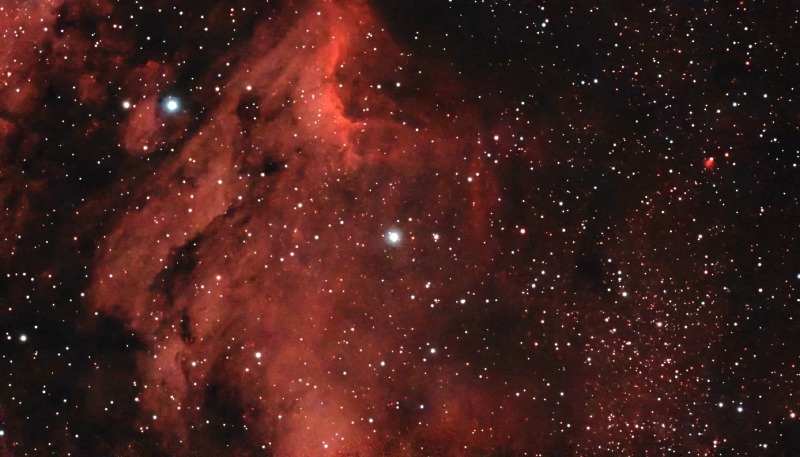 This is IC 5070 in the constellation of Cygnus, the Swan, taken last night from our garden with the Dwarf Mini. Also known as the Pelican Nebula. Can you see the pelican?
And in a weird coincidence, this was in today’s news…
As always, more information and photos on our ROAST site.
Moon and Venus Conjunction
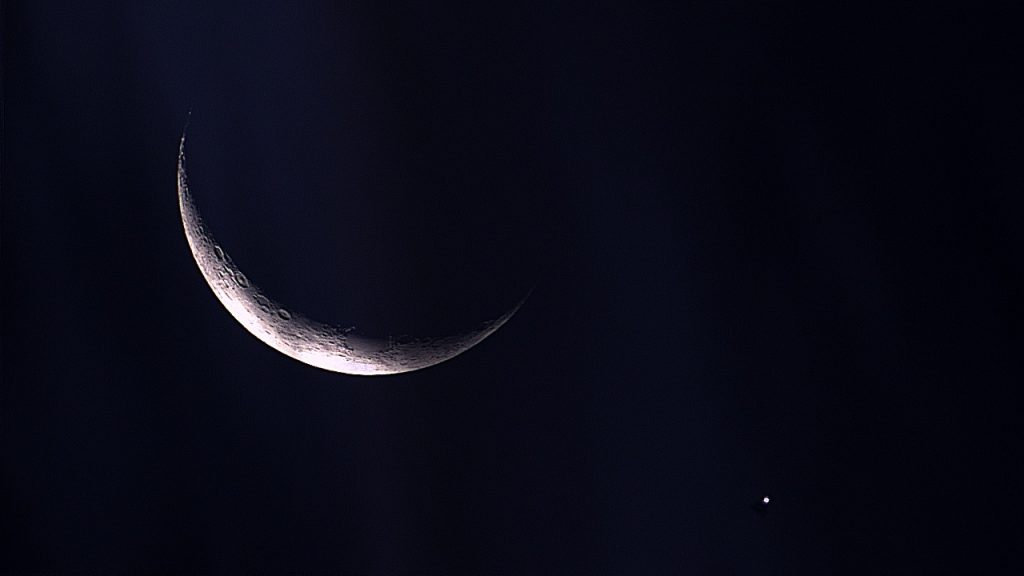 Taken with the Dwarf Mini. And this is A2’s preferred shot, from the Canon:
 A nice atmospheric sunset shot of the coppery moon with the silvery planet floating directly above.
A2 is rereading London Rules by Mick Herron.
Planets
 Venus and Jupiter caught between clouds and telephone wires, with Mercury behind a tree.
A2 is rereading Dead Lions by Mick Herron.
Phew, What a Scorcher
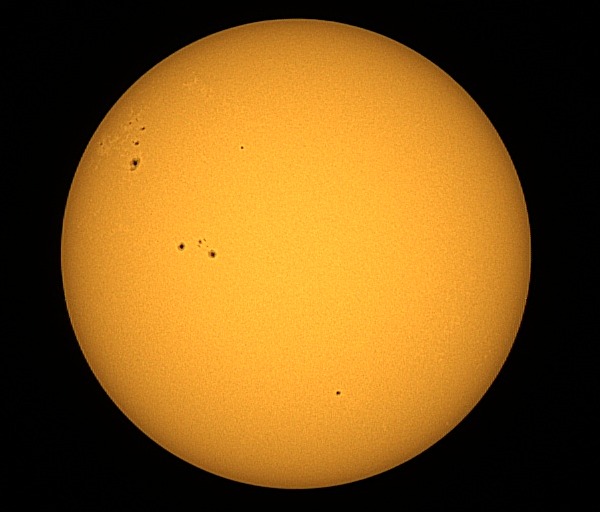 Our hottest ever day in May at 32.2°C, beating 32.0°C on 28 May 2012 (but that was with the old weather station, which over-read by 4 or 5 degrees in direct sunshine). Record-breaking throughout the country, too.
A2 is chilling out with a reread of The Darkness Knows by Arnaldur Indridason; a frozen corpse is discovered in a glacier. Cool.
Star Trails, and Meteors
The Lyrids meteor shower — a remnant of Comet Thatcher, no relation — has started, and though it doesn’t peak until the 22nd April, the sky was clear last night so we thought it was worth seeing if the Dwarf Mini could image them. It has a “star trails” setting, which takes a load of pictures with the wide-angle camera, combines them and produces a video of the result. We left it running for 3 hours (producing over 1000 photos) and got this:
At about 5 seconds, a pair of short trails appears at the upper right, which we’re fairly sure are meteors as they’re pointing directly towards the shower’s radiant in Lyra/Hercules. We’ll try again later, weather permitting; the night of 21st is forecast clear.
(Ignore the ghostly artefacts — it was shot from indoors through an open window and caught some reflections from the glass.)
Welcome Comet C/2025 R3 (PanSTARRS)
 Another marvel from the Dwarf Mini; captured by A1 in the wee small hours in a gap between trees.
More info on Roast with a bonus North America Nebula. Update: Here’s a better photo, taken the next morning:
 Our bathroom book is The Single Helix 100 short science essays by Steve Jones, which has well-timed chapters: one for a no.1, two for a no.2.
Storm Dave
 Dave blew in today and rattled all the trees but the night is calm and clear and A1’s telescope is out looking for pinwheels and cigars.
A1 is reading Eyes of the Void by Adrian Tchaikovsky. A2 is rereading Oryx and Crake by Margaret Atwood.
Moon Shot
 A1 is reading Shards of Earth by Adrian Tchaikovsky and A2 is reading The Player of Games by Iain M Banks so here is a lovely half moon (thx Dwarf Mini) to go with our science fiction enjoyment.
Pleiades
 So here are the Seven Sisters, low in the sky, photographed in the front garden under a street light, and the Dwarf Mini still made a decent shot of it.
A1 is reading The Jigsaw Man by Nadine Matheson.
Moon of Eid
 A delicate crescent moon for Eid, Nowruz, the vernal equinox and the International Day of Happiness.
A2 is rereading The Sub by Thomas M Disch.
Pie Day II and Mother’s Day Too
 Dave was unable to join us due to an overdose of beer but the other mothers and children enjoyed this hearty vegetarian pie followed by a chocolate orange cake. Sadly without the Davester we only managed to scrape 10 on the GSQ.
Meanwhile, A1 has been on a Galaxy Quest…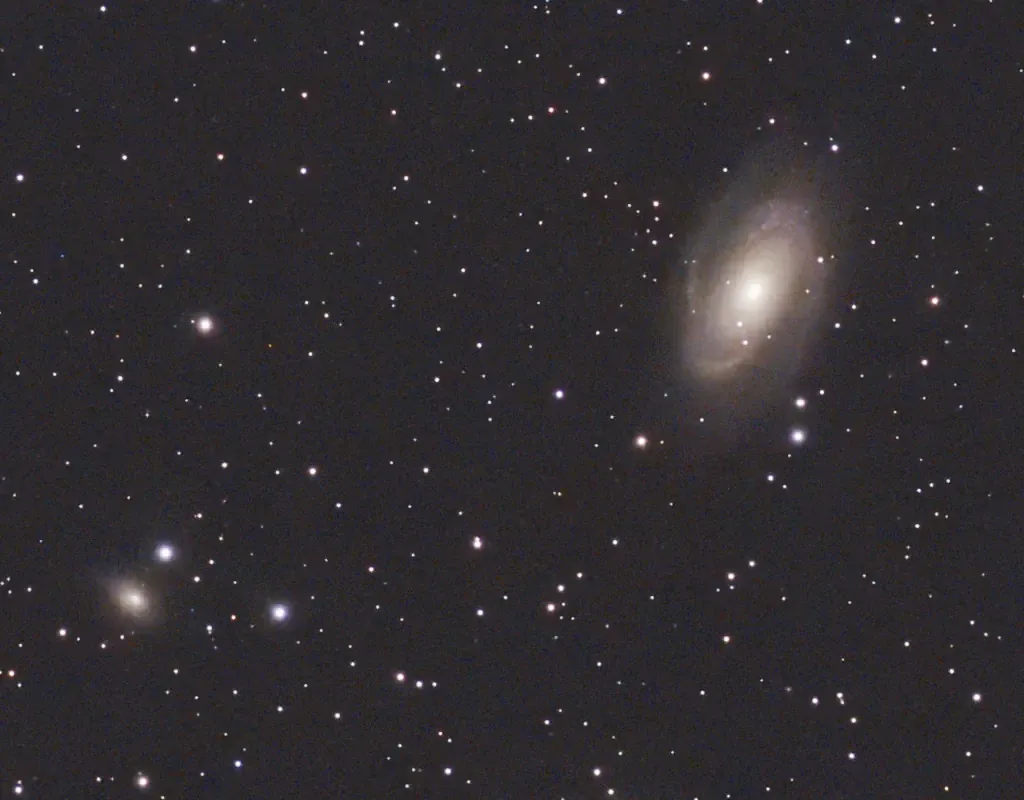
…and found Bode’s galaxy in the Great Bear constellation. More images here, on our other blog.
A2 is reading The Four by Ellie Keel which was unmitigated tripe.
String of Spots
 Today’s sun through the Dwarf Mini, on a rather hazy day. Some evidence of solar plages at lower right (the slightly paler areas).
A Nice Rosette
A couple of clear hours tonight, and here’s the Rosette Nebula, another pretty object near Orion:
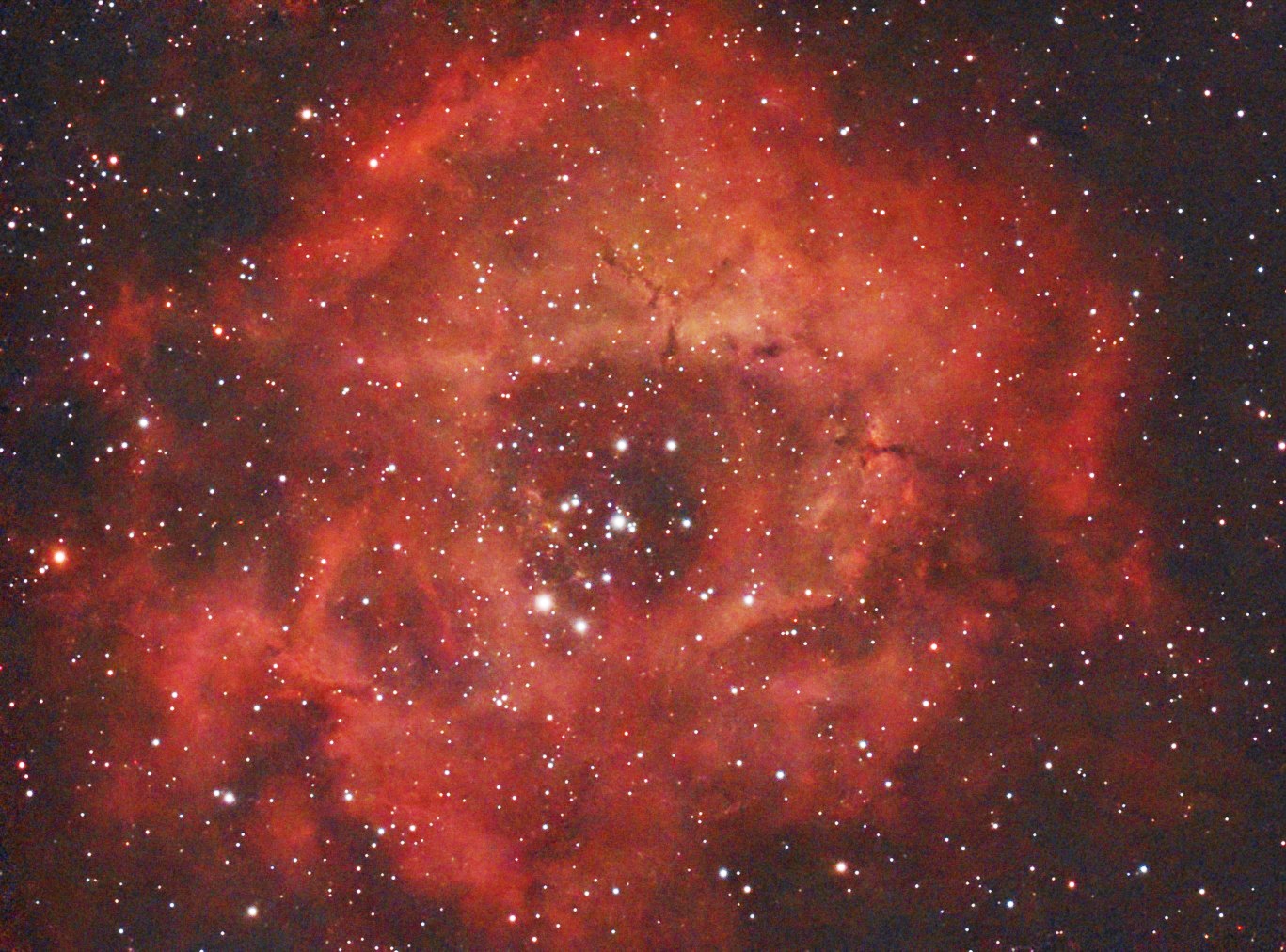 I took 100 15-second shots with gain 90; 92 were usable. I used the dual narrow-band filter which is tailored for various emission spectra, namely hydrogen alpha and beta, and oxygen III. It also reduces sky pollution and any glow from the Moon, which was very bright tonight (and quite close to the Rosette nebula). Speaking of which:
 I was going to try out the “Star Trails” setting, included in the latest software update. But guess what? Along came the clouds…
Clear Skies, at Last!
And here are some pictures from our Dwarf Mini. All taken from our light-polluted suburban back garden, with a bright half-moon. The scope was plonked down on our patio table, and left to get on with it. No special mounting or alignment needed.
First (and best!), M42 aka the Orion Nebula:
The scope took 32 shots each of 15-second exposure, 28 of which were usable and stacked together. Quite remarkable, especially compared to our photo of M42 taken with a large professional telescope at COAA during our visit in 2001.
Next up, the Flame Nebula. A lot fainter, so needed a contrast boost:
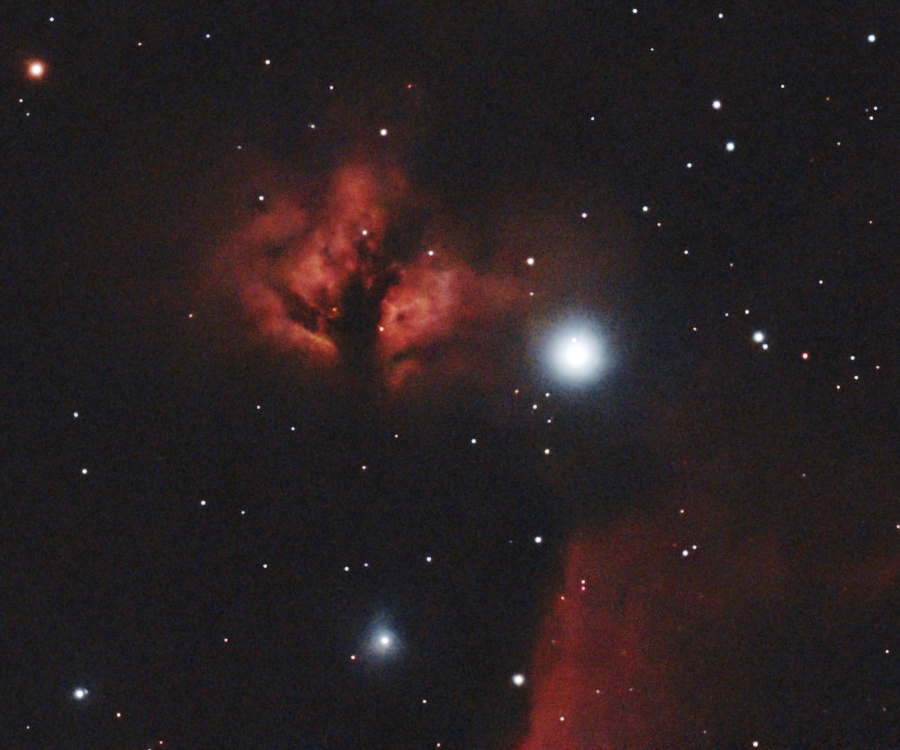 Here’s Jupiter with the four Galilean moons, showing the Dwarf Mini isn’t really meant for planetary imaging. Left to right: Callisto, Ganymede, Europa and Io (checked with Stellarium):
 And lastly, the good old Moon:
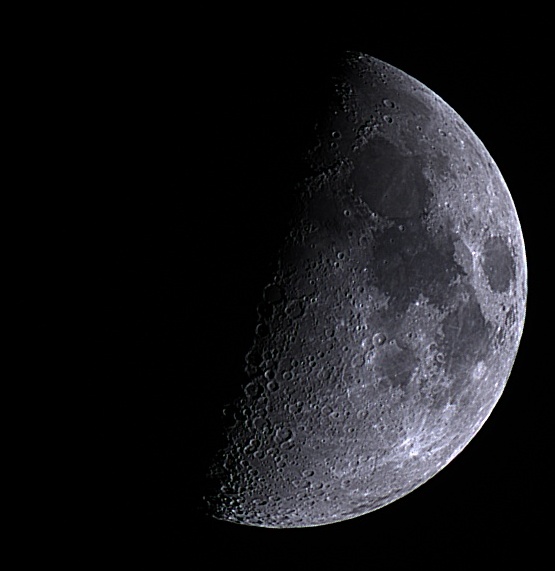 A2 is rereading A Scanner Darkly by Philip K Dick.
Fly Me to the Moon
Our last post was about dinner at the ivy and tonight a boy called Ivy joined us for our family dinner but nobody thought to take a picture. Instead here are a couple of shots from A1’s Dwarf Mini telescope: some iridescent starlings and the crescent moon.

 The menu for tonight was spag bol followed by nectarine cake and the GSQ at which we scored 10.5.