While preparing for last night’s Dwarf Mini observing session (details here), A1 tried out his new phone, a Pixel 10a, on its astronomy setting. And accidentally caught the International Space Station as it flew overhead:
Author: admin1
An Active Sun
Between 23 June and 5 July some sunspots moved across the Sun as it rotated (it takes about 25 days to rotate fully). I managed — with some difficulty! — to photograph the Sun with the Dwarf Mini every day until 3 July, when the clouds moved in. I then made this video, showing the spots as they developed and moved across the face of our star.
This isn’t perfect. The images were all taken at different times so they needed rotating to orient them correctly … which is quite hard to do with something like the Sun. Still, a first effort.
Coincidentally, these spots erupted in flares during this time, and caused massive auroras over the US on their Independence Day.
A2 is reading Quite Ugly One Evening by Chris Brookmyre.
Busy Mini
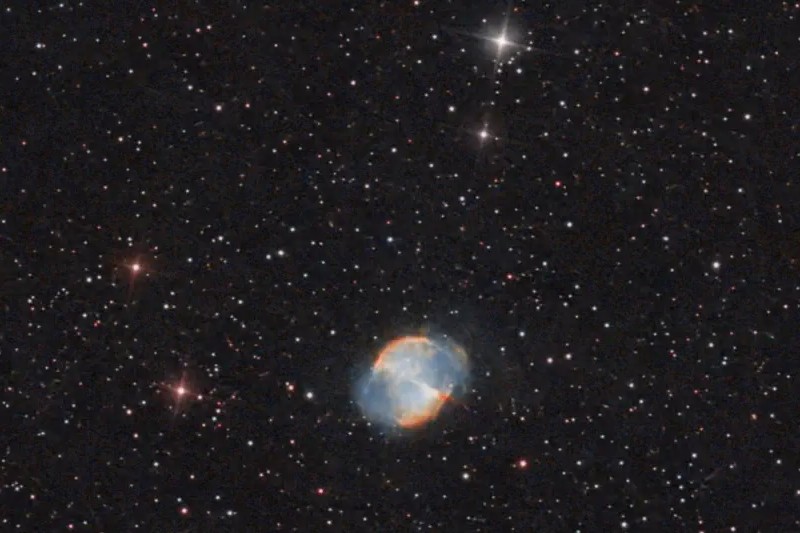
Here are a few recent pics from our Dwarf Mini telescope. This is the Dumbbell Nebula, in Vulpecula (The Fox):
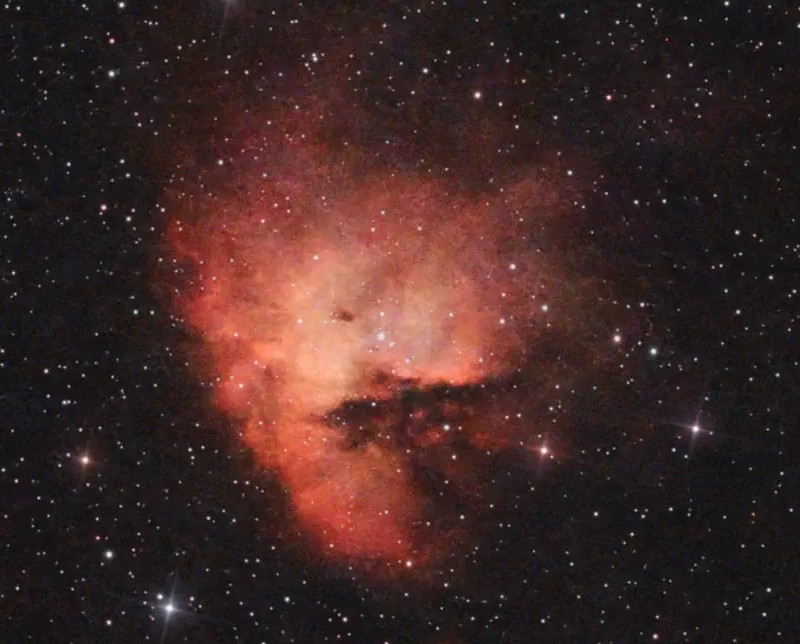
The Pac-Man Nebula, in Cassiopeia:
 And the Andromeda Galaxy in, er, Andromeda:
 Much bigger versions and more details on our ROAST blog.
A1 is reading The Ides of April by Lindsey Davis. A2 is reading Seascraper* by Benjamin Wood, a poignant and atmospheric book about a shrimp catcher which had echoes of Beryl Bainbridge. BW is on record as admiring The Dressmaker.
Spot the Spots
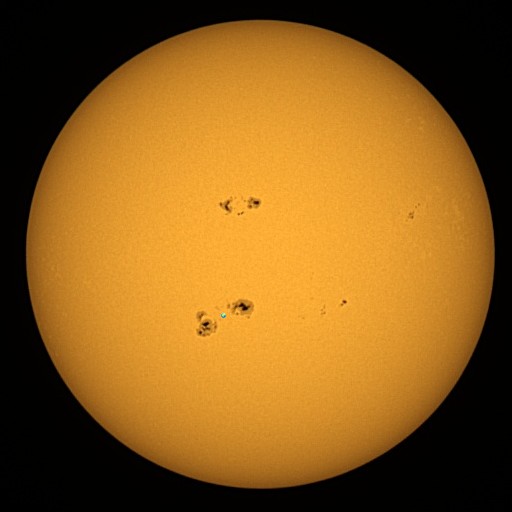
The sun has been very spotty recently, and this was taken this morning during a break in the clouds.
But what’s that greeny-blue dot between the pair of large sunspots? That’s us, that is. The Earth, roughly to scale; you can fit 109 Earths in the diameter of the Sun. Here it is zoomed in:
 A1 is reading Quite Ugly One Evening by Chris Brookmyre. Thanks A2! CB’s first published novel was Quite Ugly One Morning (1996), which introduced his journalist protagonist Jack Parlabane, and this novel continues — and possibly wraps up — Parlabane’s (rather doleful) character arc. While CB’s writing no longer provokes LOLs at his wonderful outrageousness (like the abseiling scene in Be My Enemy, or the unfortunate bodily invasion in Boiling a Frog), he continues to take aim at his bêtes noires — in this case MAGA loonies, influencers, fanboyz, right-wing fanatics with a complete disregard for morality, and rich bastards. All easy targets perhaps, and the tale is complicated by an excess of characters in the family under investigation, who created a 1960s puppet show not a million miles from Thunderbirds. Much is revealed about Parlabane’s background, and he perhaps achieves some kind of redemption. A satisfying read.
So Now We Know…
…who’s been stealing our cherries.
Today was the hottest day of the year so far, at 33.7°C. In fact, it was the hottest day since the notorious 19 July 2022, when we got to 39.2°C.
Web Surfing
A very warm and humid day (31.9°C) to start the heatwave, so we opened the windows in the bedroom. It was gusty, and down came a very impressive cobweb.
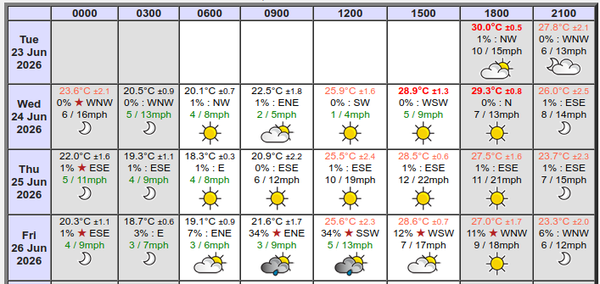
Here’s the Met Office forecast for the next couple of days. It’s not often we get red temperatures (max over 25°C) at midnight, and it looks like tonight might be tropical — which is when the temperature stays above 20°C.
A Pelican in a Swan
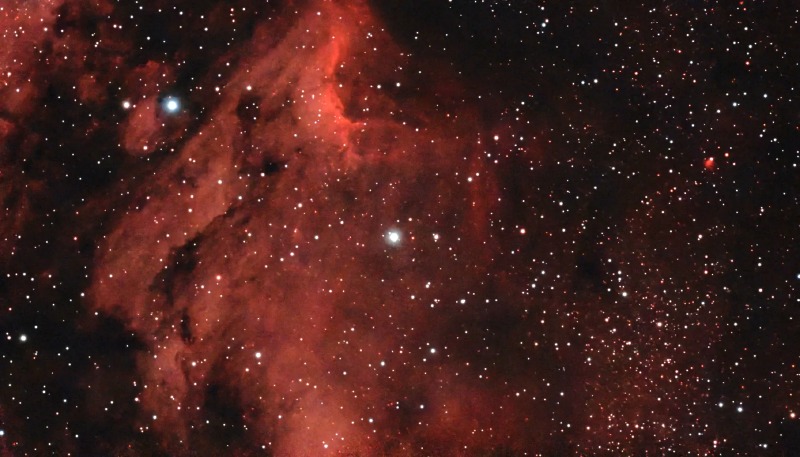 This is IC 5070 in the constellation of Cygnus, the Swan, taken last night from our garden with the Dwarf Mini. Also known as the Pelican Nebula. Can you see the pelican?
And in a weird coincidence, this was in today’s news…
As always, more information and photos on our ROAST site.
Moon and Venus Conjunction
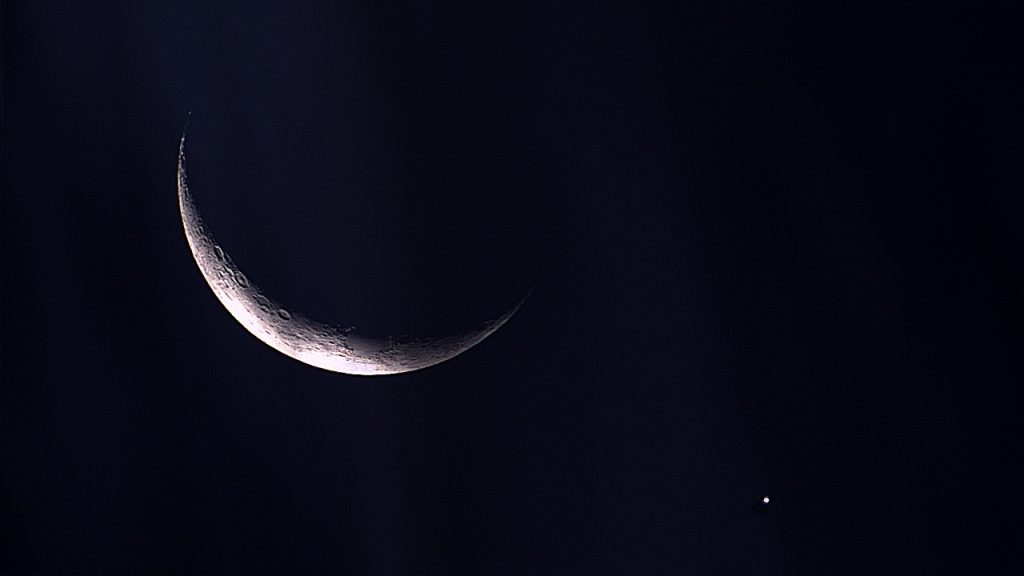 Taken with the Dwarf Mini. And this is A2’s preferred shot, from the Canon:
 A nice atmospheric sunset shot of the coppery moon with the silvery planet floating directly above.
A2 is rereading London Rules by Mick Herron.
Spin Cycle
Another rider on the anemometer merry-go-round/ Look at that pigeon go!
A2 is reading City of Saints and Madmen by Jeff Vandermeer; a compendium of novellas concerning the imaginary city of Ambergris, with an appendix at least as long including information about squids, a partially decoded cryptic text, bibliographies, glossaries and tasting notes on the fonts employed. Reading it I was struck by the similarity to the works of Alasdair Gray and sure enough it turns out that Jeff is a massive fan of Alasdair and cites him as a mentor. Books send out hyphae into the literary subsoil and somewhere far away another book pops up like a mushroom.
Phew, What a Scorcher
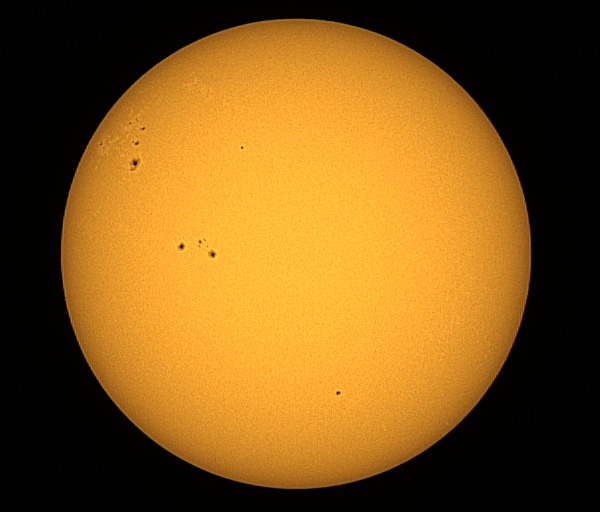 Our hottest ever day in May at 32.2°C, beating 32.0°C on 28 May 2012 (but that was with the old weather station, which over-read by 4 or 5 degrees in direct sunshine). Record-breaking throughout the country, too.
A2 is chilling out with a reread of The Darkness Knows by Arnaldur Indridason; a frozen corpse is discovered in a glacier. Cool.
The Rain It Raineth…
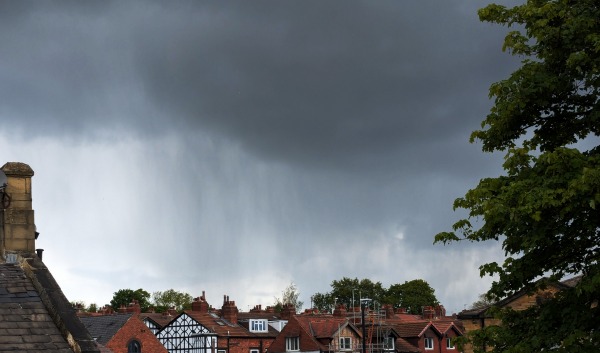 …over Roundhay, seen from the library roof.
A2’s bathroom book is Think like an Engineer by Guru Madhavan.
Star Trails, and Meteors
The Lyrids meteor shower — a remnant of Comet Thatcher, no relation — has started, and though it doesn’t peak until the 22nd April, the sky was clear last night so we thought it was worth seeing if the Dwarf Mini could image them. It has a “star trails” setting, which takes a load of pictures with the wide-angle camera, combines them and produces a video of the result. We left it running for 3 hours (producing over 1000 photos) and got this:
At about 5 seconds, a pair of short trails appears at the upper right, which we’re fairly sure are meteors as they’re pointing directly towards the shower’s radiant in Lyra/Hercules. We’ll try again later, weather permitting; the night of 21st is forecast clear.
(Ignore the ghostly artefacts — it was shot from indoors through an open window and caught some reflections from the glass.)
String of Spots
 Today’s sun through the Dwarf Mini, on a rather hazy day. Some evidence of solar plages at lower right (the slightly paler areas).
A Nice Rosette
A couple of clear hours tonight, and here’s the Rosette Nebula, another pretty object near Orion:
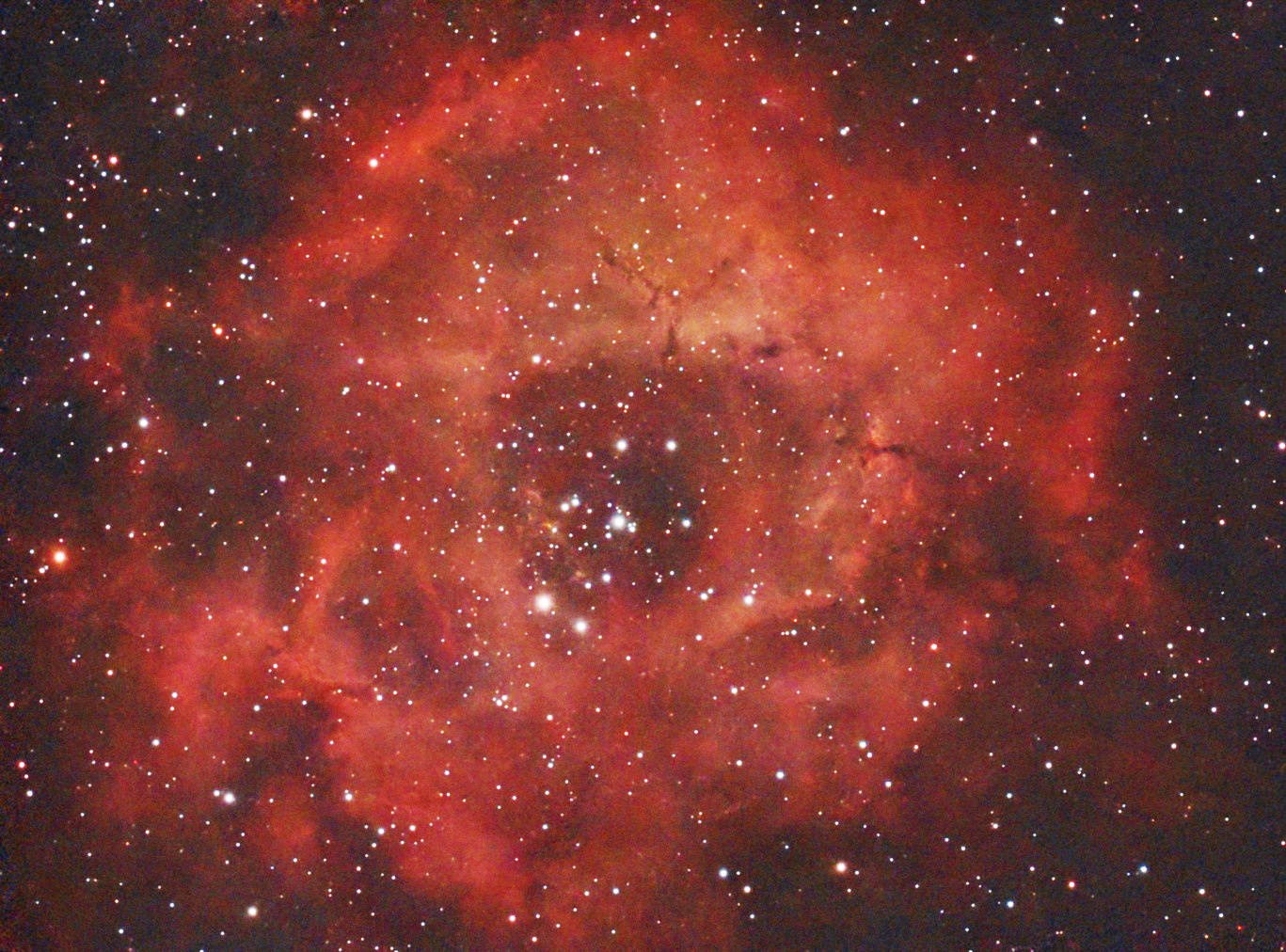 I took 100 15-second shots with gain 90; 92 were usable. I used the dual narrow-band filter which is tailored for various emission spectra, namely hydrogen alpha and beta, and oxygen III. It also reduces sky pollution and any glow from the Moon, which was very bright tonight (and quite close to the Rosette nebula). Speaking of which:
 I was going to try out the “Star Trails” setting, included in the latest software update. But guess what? Along came the clouds…
Clear Skies, at Last!
And here are some pictures from our Dwarf Mini. All taken from our light-polluted suburban back garden, with a bright half-moon. The scope was plonked down on our patio table, and left to get on with it. No special mounting or alignment needed.
First (and best!), M42 aka the Orion Nebula:
The scope took 32 shots each of 15-second exposure, 28 of which were usable and stacked together. Quite remarkable, especially compared to our photo of M42 taken with a large professional telescope at COAA during our visit in 2001.
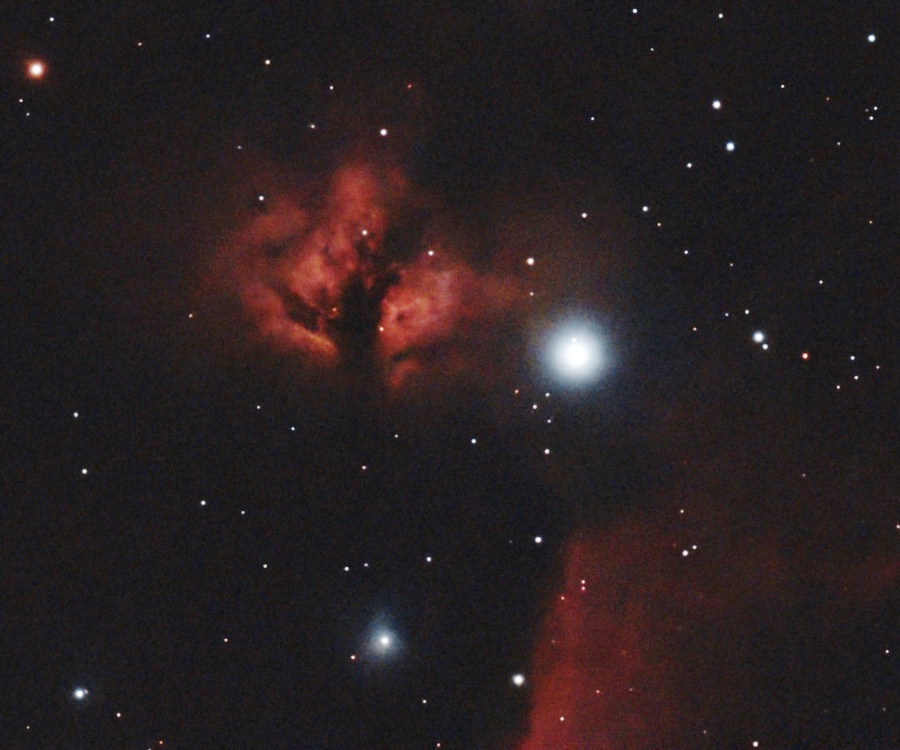
Next up, the Flame Nebula. A lot fainter, so needed a contrast boost:
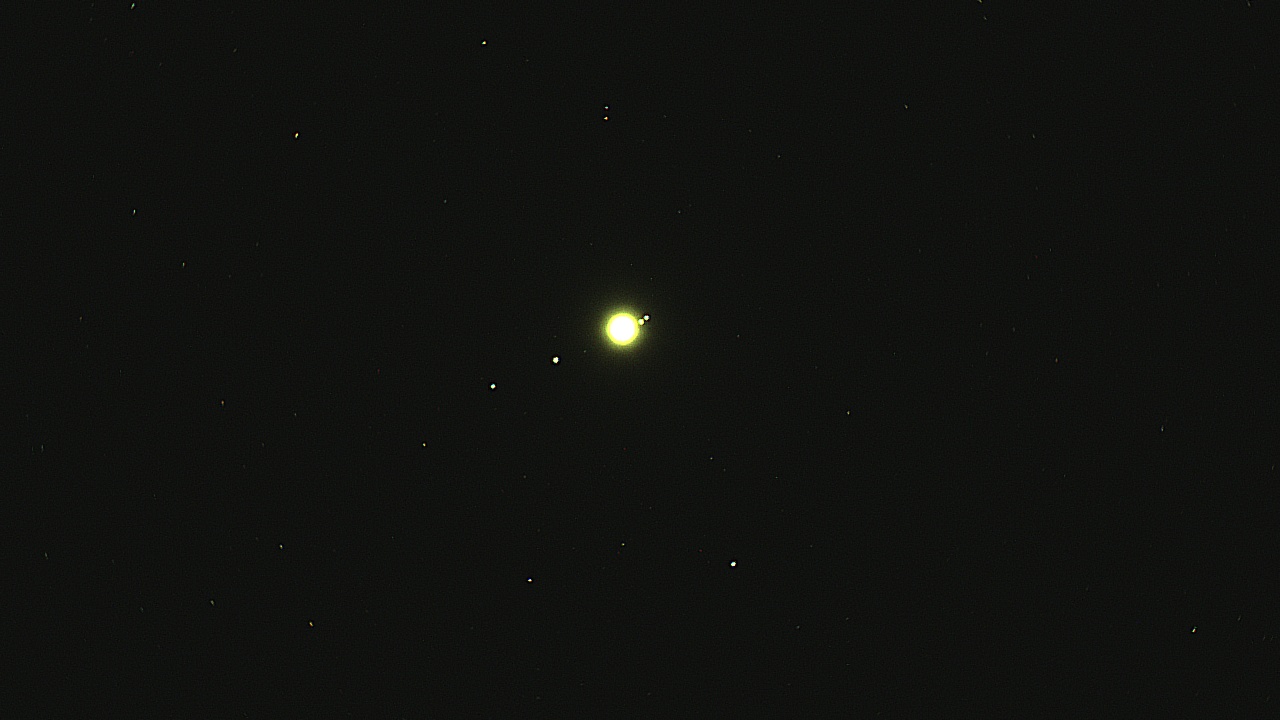
 Here’s Jupiter with the four Galilean moons, showing the Dwarf Mini isn’t really meant for planetary imaging. Left to right: Callisto, Ganymede, Europa and Io (checked with Stellarium):
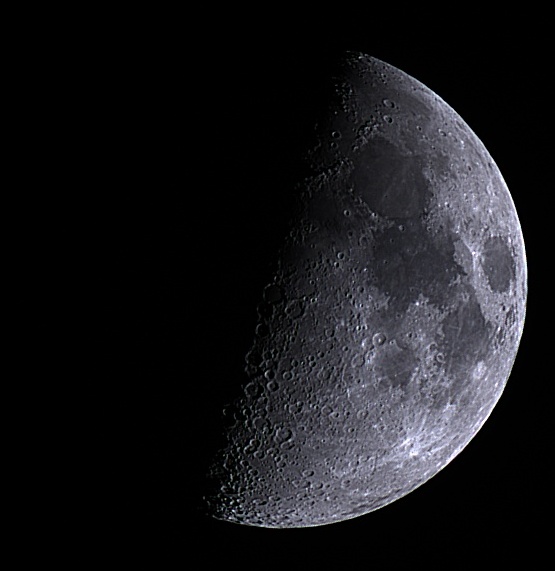
 And lastly, the good old Moon:
 A2 is rereading A Scanner Darkly by Philip K Dick.
Dwarf Mini first light
 A new toy! The Dwarf Mini is an ultra-portable smart telescope designed for deep-sky astronomical imaging. Controlled from a smartphone (in our case a Pixel 6a), it can track objects, take multiple exposures and automatically stack them to increase the image quality.
This hasn’t been a good time for astronomy here — we’ve had unrelenting gloom, rain and cloud cover for the last couple of months. But today, Valentine’s Day, the sky finally cleared enough to try the device out. The picture above is the sun, showing three groups of small sunspots. It’s a stack of 20 shots each exposed for 1/200s. The tracking was spot-on, with no need for special mounts or alignment — the device was indoors looking through an open window. Here’s a screenshot from the phone before it was taken (note the very useful inset wide-field picture):
At about 1:30am this morning the sky started to clear with some gaps in the clouds. I took a test sequence of a random part of the sky, centred on the star HIP80364. The Dwarf Mini took 21 15-second shots , of which 16 were usable — the device detected occasional cloud cover and discarded them. Again the tracking was perfect, with no discernable trails or elongation of the stars (click for full size):
 That’s a rather boring image, but given clearer weather we can hopefully do better. Oh, and it’s also good for wildlife:
 A2 is reading Signals of Distress by Jim Crace.
Pigeon Pie
Back in 2020 we had an unexpected visitor: a sparrowhawk feasting on its prey in our back garden. The picture in the linked post was a still from a rather poor video, which we’ve now improved somewhat:
We thought the prey was a magpie originally, due to the racket being made by a flock mischief of them which attracted our attention. But now it’s looking more like it was a pigeon.
Thanks to the very powerful software ffmpeg, the video has been stabilised, sharpened and colour balanced.
A1 is reading Halcyon Years by Alastair Reynolds — thanks A2! AR likes incorporating both noir and detective elements in his SF (cf the terrific Century Rain and the Prefect Dreyfus novels), and here we’ve got Yuri Gagarin — well, sort of — as a mean-streets PI on a generation starship. There are touches of humour, and some Dickian nods in this tale: the sorrowfully forgetful robot, and the excessively polite one as it chucks our hero overboard. It all hangs together though, and a return to form.
A2 is rereading Alias Grace by Margaret Atwood.
6202 emocleW
Fireworks in the far distance, played backwards as 2025 disappears into history.
Our weather station malfunctioned at various points in the year, with the base unit failing in June and the business end packing in in December; consequently none of the statistics are reliable. However the solar panels soldiered bravely on and served up 1,530.932kWh, making 2025 our second best year ever.
A1 is rereading Bad Actors by Mick Herron.
All the Colours of Bram
And the following morning, a brief but lurid sunrise:
Roasted
Roast beef, Yorkshire puddings, roast potatoes, sprouts, broccoli, stuffing balls, gravy … but A1 forgot to serve the carrots. But never mind, Gez scoffed the lot anyway. Plus A2’s delicious afters of Squidgy Chocolate Pear Pudding and cream, after which we scored 13 on the GSQ with Bob as quizmaster.
A1 is rereading The Stand by Stephen King. A2 is reading Desolation Road by Ian McDonald.
It’s Coming…
Yes, the season of … well, trying to avoid it. The shops are full of it, and still a month to go. And last week the Chapel Allerton willow tree got its lights.
A2, who walked to the shops today, but not those shops, is rereading The Priest by Thomas M Disch.
Halloween Spider…
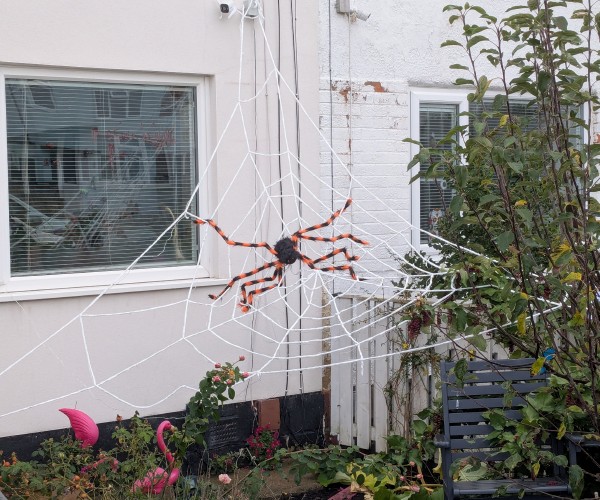
…looking for a nice snack of a flamingo. And later, a double rainbow:
 October 2025 was our coldest and least sunny October ever recorded. It was averagely wet though. A2 is rereading Shrines of Gaiety by Kate Atkinson.
Watts Going On
 On the 300th day of the year, we’ve managed to reach 1,500.000kWh precisely in our solar panel output for this year. So giving an average of exactly 5.000kWh per day.
This year was looking like it would be our best ever for the panels, but that was probably scuppered by the very gloomy October. It’ll probably be only second best.
A2 is reading The Rose Field by Philip Pullman, which finished off the trilogy beautifully. Like with the knee replacement, she has been waiting for this for 6 years, with covid to blame in both cases.
Kneedful Things


A2 is indisposed, getting a new knee, so no family meal or quiz today. But here are some photos taken in the hospital grounds during various visits. Primrose and autumn leaves above, and some splendid fungi on the right.
Get well soon, A2!
[later] A2 is back. And A1 is rereading — of course — Needful Things by Stephen King.
Diwali
Some Diwali fireworks. The first few were local, followed at 9pm by the main event at the Sikh Temple. Obscured by trees from here, but still a splendid display.