Chasing variable stars
The globular cluster M13 has a number of variable stars, which change in brightness by various amounts over time. Some, like Cepheid variables, are very predictable and can be used to estimate the distance of objects.
I surmised it might be possible to catch the variations with the Dwarf Mini, so after taking the 27 March image, I took another the next night in a brief cloudless spell and tried comparing them. Spoiler: this hasn’t worked very well!
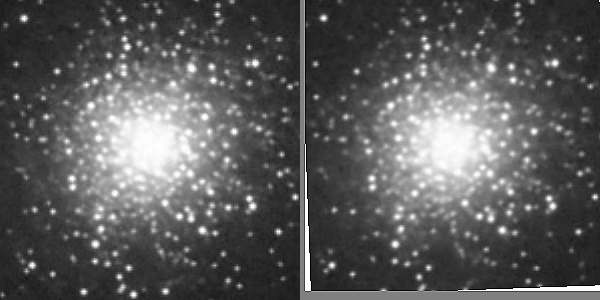
The image on the left is an animation of the two images. Both were taken with the same settings: 50 30-second exposures, 60 gain, Astro filter.
First of all the images had to be aligned. Because they were taken at different times the second had to be rotated by a small amount (about 2.1°), which was done in ArtWorks — it’s a bit easier than in PhotoDesk. The images were then imported into PhotoDesk and aligned using a layer for each image.
There are some obvious problems here. First, the images should have been taken at similar times. The second was taken earlier in the evening, so M13 was lower in the sky resulting in greater atmospheric attenuation, which alters the colours slightly — that’s why they’ve been converted to greyscale — and dims the image a bit. This would also reduce or eliminate any need for rotation.
Second, the weather for the second image was worse, with occasional cloud and some high haze.
Third, it turns out that most of the variables have fairly long cycles, between five days and three months, so the two photos should be separated by more than a day. And the amount of variation isn’t that much, so the two images do need to be as identical as possible.
So although it looks like some stars are varying, mostly fainter ones, this is an artefact. And they’re not quite aligned perfectly either.
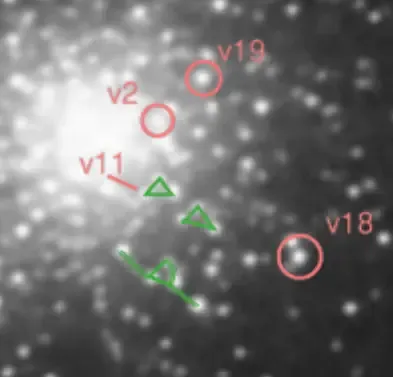
This Sky and Telescope article has a useful guide to M13 variable stars. About halfway down the page there’s an annotated image with the variable stars labelled and some asterisms — star patterns — outlined as guide aids. My image is on the right, and I’ve matched the asterisms, shown in green — an encouraging start — and marked a few of the variable stars, in red. It’s been zoomed in and cropped.
So my first attempt was, basically, rubbish. But I’ve learned a lot here…