More Horsehead, and an Asteroid!
November 20, and another completely clear night after a week of cloud. Quite pleased with the Horsehead sessions, so here’s another one:

This is a megastack of all three sessions, but last night’s was done with the Astro filter to bring out a bit more of NGC 2023, the small reflection nebula below the Horsehead. I’ve also tweaked the colour balance slighly, a -14 Y>B shift.
I stupidly didn’t modify the session time from the previous go, and the Horsehead moved behind a house at 1:58 leading to the 30 failures. Doh.
In a weird coincidence, the previous day’s APOD (Astronomy Picture of the Day) was the same target. Obviously APOD’s example was taken with much better equipment (and vastly more expensive: about £30,000 rather than £380!). But the comparison is interesting.
Details:
Target: HD 37903 (Lump Star; includes Horsehead and Flame Nebulae)
Megastack session 1:
Equipment: Dwarf Mini, Duo-Band, perfect EQ
Time: 2026-11-12 00:25-02:26
Integration: 1hr 50mins (110×60secs, +6 failures), gain 60
Conditions: Clear; Bortle 6
Megastack session 2:
Equipment: Dwarf Mini, Duo-Band filter, perfect EQ
Time: 2026-11-13 00:06-02:22
Integration: 2hr 2mins (122×60secs, +11 failures), gain 80
Conditions: Clear; Bortle 6
Megastack session 3:
Equipment: Dwarf Mini, Astro filter, perfect EQ
Time: 2026-11-21 00:04-01:57
Integration: 1hr 43mins (103×60secs, +30 failures), gain 60
Conditions: Clear; Bortle 6
Total integration: 5hrs 35mins
Processing: PhotoDesk equalisation, gamma, crop, rotation, usm 5,60,2, Y>B -14
I also did the Pleiades again, and noticed a short streak at the bottom of this unprocessed image:
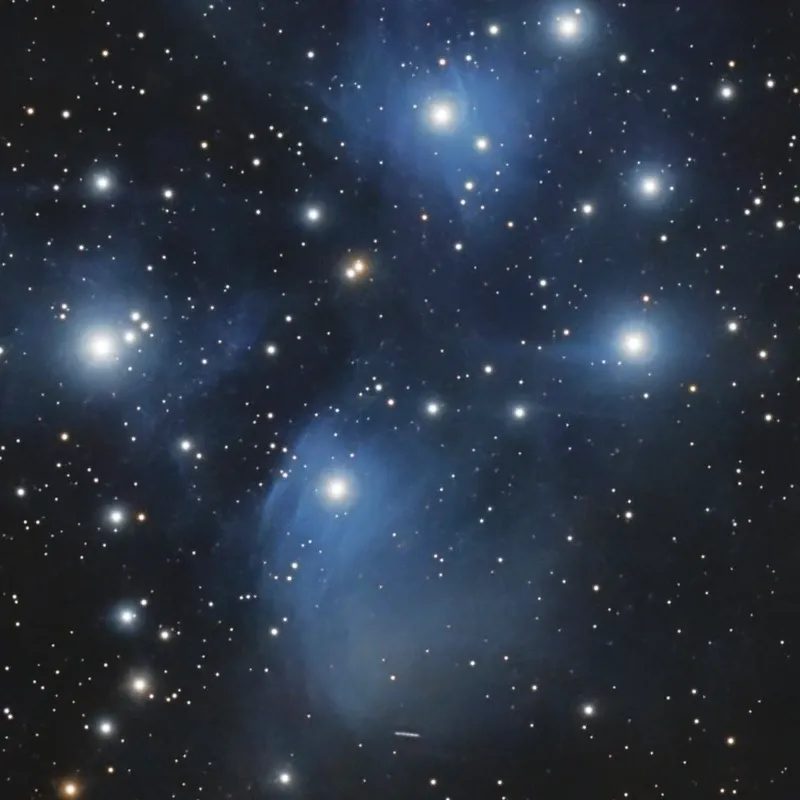
I haven’t been able to identify it (possibly Beatrix), but it’s definitely an asteroid.
And so to bed…
All-nighter
November 12, and a completely clear night at last. The all-night schedule included M 31 (Andromeda Galaxy), the Pleiades. another go at the Horsehead Nebula, and M 81 (Bode’s Galaxy).
A note on power. The Mini was running continuously from 17:30pm to 6:00am the next morning, so 12½ hours. The Mini and the connected power bank were both fully charged to start with, and at the end the Mini’s battery stood at 20%; the schedule completed successfully. (If the internal battery drops below 10% the Mini will close itself down.) The power bank is a Tronic-branded item from Lidl, rated at 20,000mAh, and costs about £15. So to run the Mini all night needs a power bank with that rating. It was a cold night (below 0°C at times) which may affect the battery efficiency.
So, next morning I did a megastack of the two Horsehead Nebula sessions:
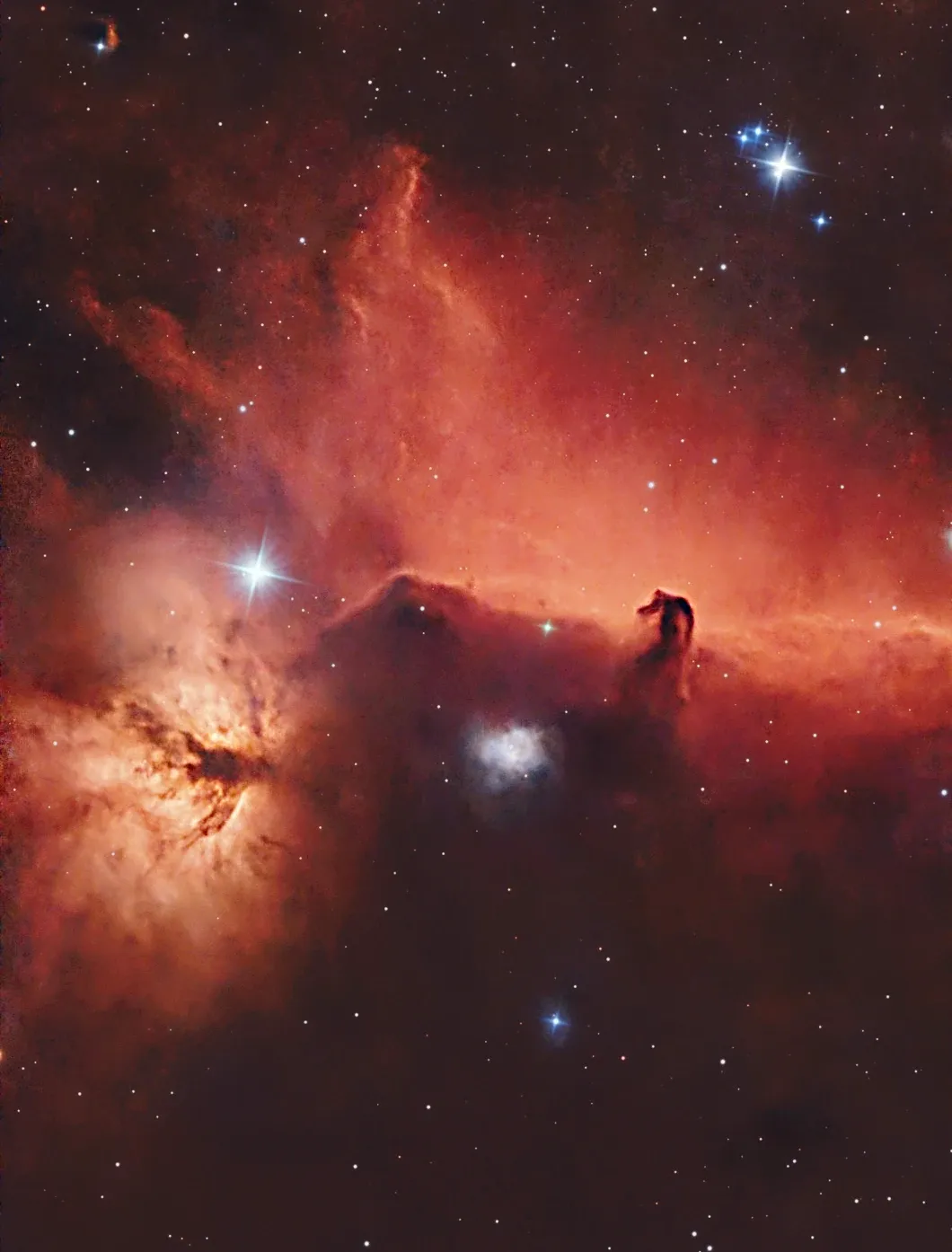
This has brought out some of the fainter nebulosity, and improved the detail.
Details:
Target: HD 37903 (Lump Star; includes Horsehead and Flame Nebulae)
Megastack session 1:
Equipment: Dwarf Mini, Duo-Band, perfect EQ
Time: 2026-11-12 00:25-02:26
Integration: 1hr 50mins (110×60secs, +6 failures), gain 60
Conditions: Clear; Bortle 6
Megastack session 2:
Equipment: Dwarf Mini, Duo-Band filter, perfect EQ
Time: 2026-11-13 00:06-02:22
Integration: 2hr 2mins (122×60secs, +11 failures), gain 80
Conditions: Clear; Bortle 6
Total integration: 3hrs 52mins
Processing: PhotoDesk equalisation, gamma, crop, rotation, usm 5,60,2
++++++ More to come
And so to bed…
The Horsehead Nebula
November 11, and the first clearish night for nearly a month. The clouds finally parted at about midnight which provided an opportunity for a first go at the Horsehead Nebula, Barnard 33, in Orion:

The horse’s head is a dark nebula which lies in front of, and so obscures, the long emission nebula IC 434.
Just below the horse’s head is the small blueish reflection nebula NGC 2023. The star in the centre of this is the Lump Star, HD 37903, which was used to aim the Mini so that the image would include NGC 2024, the large bright Flame Nebula on the left.
The brightest star here is Alnitak, or Zeta Orionis, the leftmost star in Orion’s belt. It’s a blue supergiant, 20 times bigger than the sun, and is a triple star sytem.
The Flame Nebula, NGC 2024, is being ionised and heated by a central star cluster which is only visible in infrared observations. Despite appearances, it’s not connected with Alnitak, which is further away.
Details:
Target: HD 37903 (Lump Star; includes Horsehead and Flame Nebulae)
Equipment: Dwarf Mini, Duo-Band, perfect EQ
Time: 2026-11-12 00:25-02:26
Integration: 1hr 50mins (110×60secs, +6 failures), gain 60
Conditions: Clear; Bortle 6
Processing: PhotoDesk equalisation, gamma, crop, rotation, usm10,60,2
The Mini failed to detect a couple of frames where the tracking was off, leading to some trails on the brighter stars. Deleting these in the app and restacking fixed it.
And so to bed…