Pleiades, a first attempt
Today started off with thick fog, which gradually cleared to hazy sunshine and milky skies. Not the best conditions for astrophotography, but I decided try shooting the Pleiades, or Seven Sisters, a prominent star cluster in Taurus.
It’s not well positioned from our location at this time of year, being lowish in the western sky. And it’s only visible from our front garden, with a bright street light just outside. Nevertheless I had a go, and set up a Heath Robinson affair of a towel — life’s essential — draped over another tripod to shade the Dwarf Mini from the glare of the street lamp.
Here’s how it went:
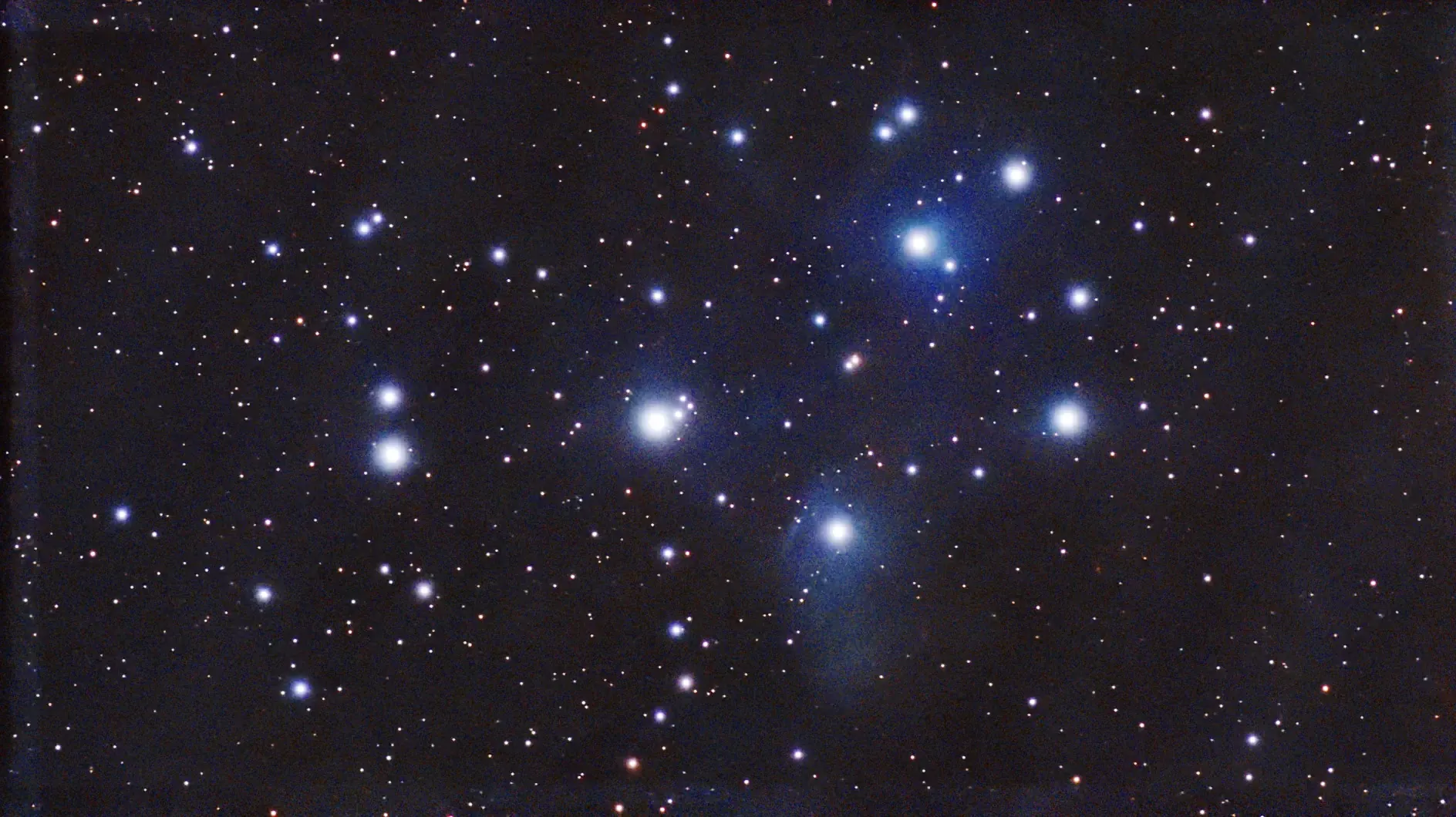
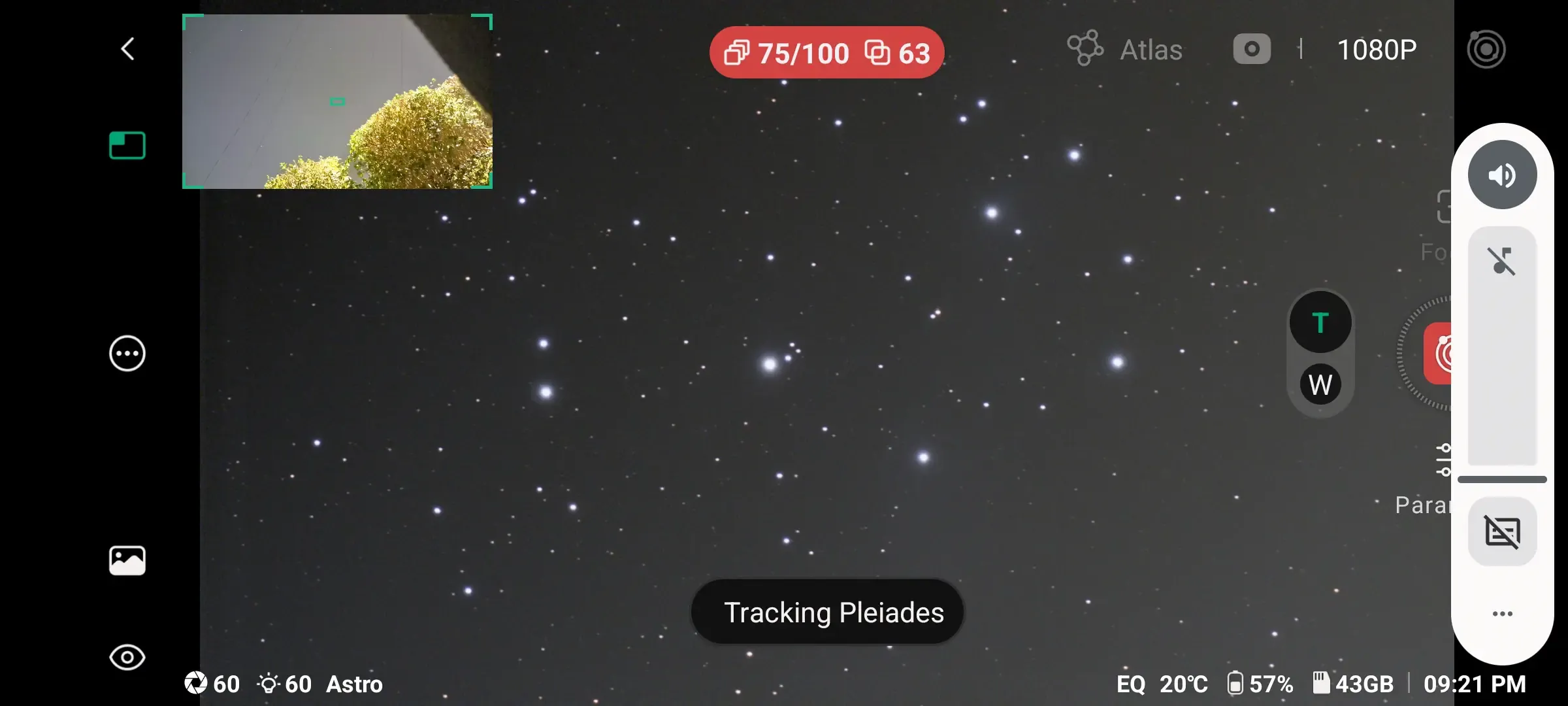
Not bad at all, considering the conditions! I set up the Mini to take 100 shots, with 60-second exposure and gain 60. But as you can see from the screenshot below, by 75 shots the hedge was getting in the way so I stopped the session. Unsurprisingly there were 12 failed shots, so this is a stack of 63. It’s been processed in PhotoDesk with equalisation and quite a strong gamma adjustment to bring out some of the faint blue nebulosity. This target really needs dark skies and long exposures, so we’ll have to wait until later in the year for a better result.
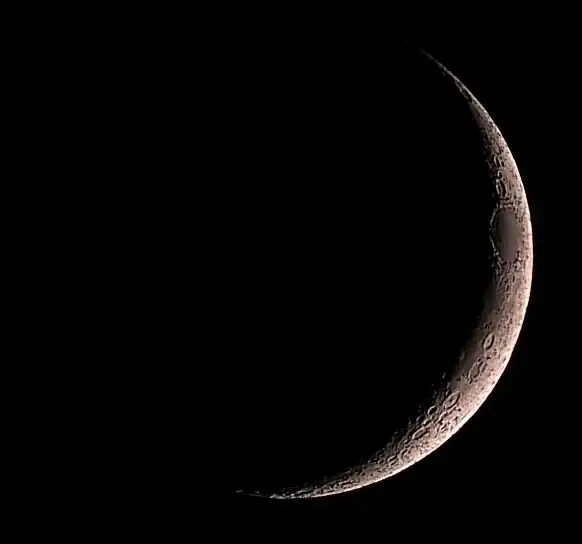
I also took a quick shot of the 3-day-old Moon:
Galaxies Update
A very clear night, and an opportunity to attempt some better shots of the galaxies I looked at last time.
I set up an equatorial mount, not “Perfect” but within 1°. I upped the exposure time to 60 seconds, and used a gain of 100. Click on the pictures for bigger versions. All have minimal PhotoDesk processing after passing through Stellar Studio — just small gamma and equalisation adjustments, and cropping.
So here’s M81, Bode’s galaxy, again. 50 exposures, two failures:
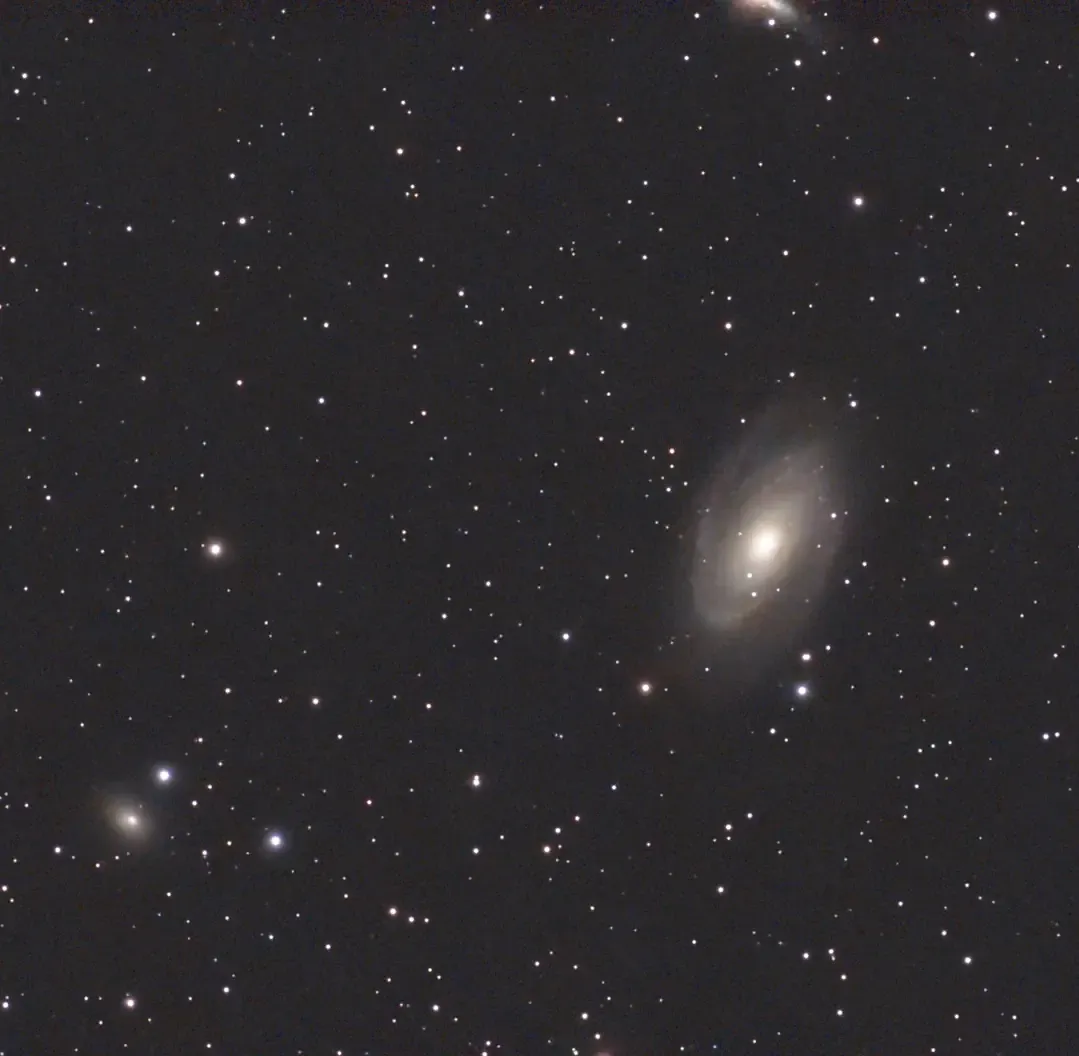
The thing at the top is the Cigar galaxy, which I didn’t realise was there.
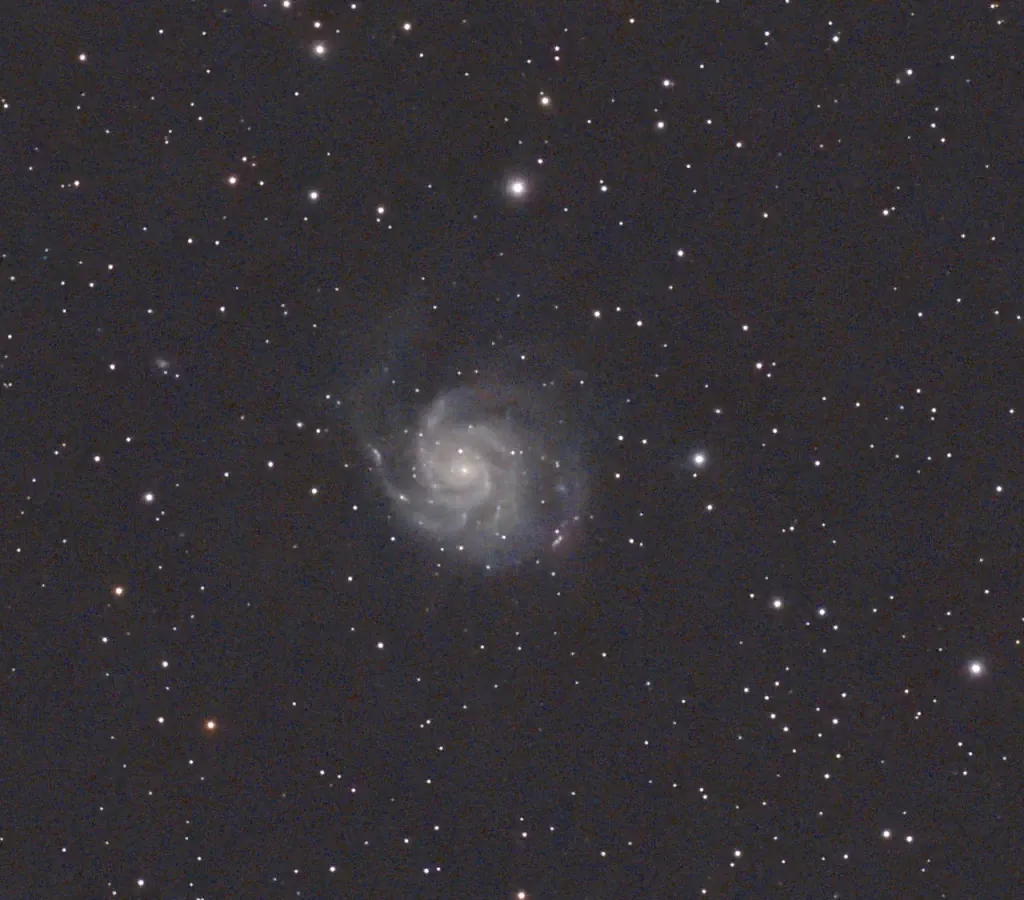
This is M101, the Pinwheel galaxy. 50 exposures, no failures:
And a new one, the small but pretty M51, the Whirlpool galaxy. 50 exposures, no failures again:
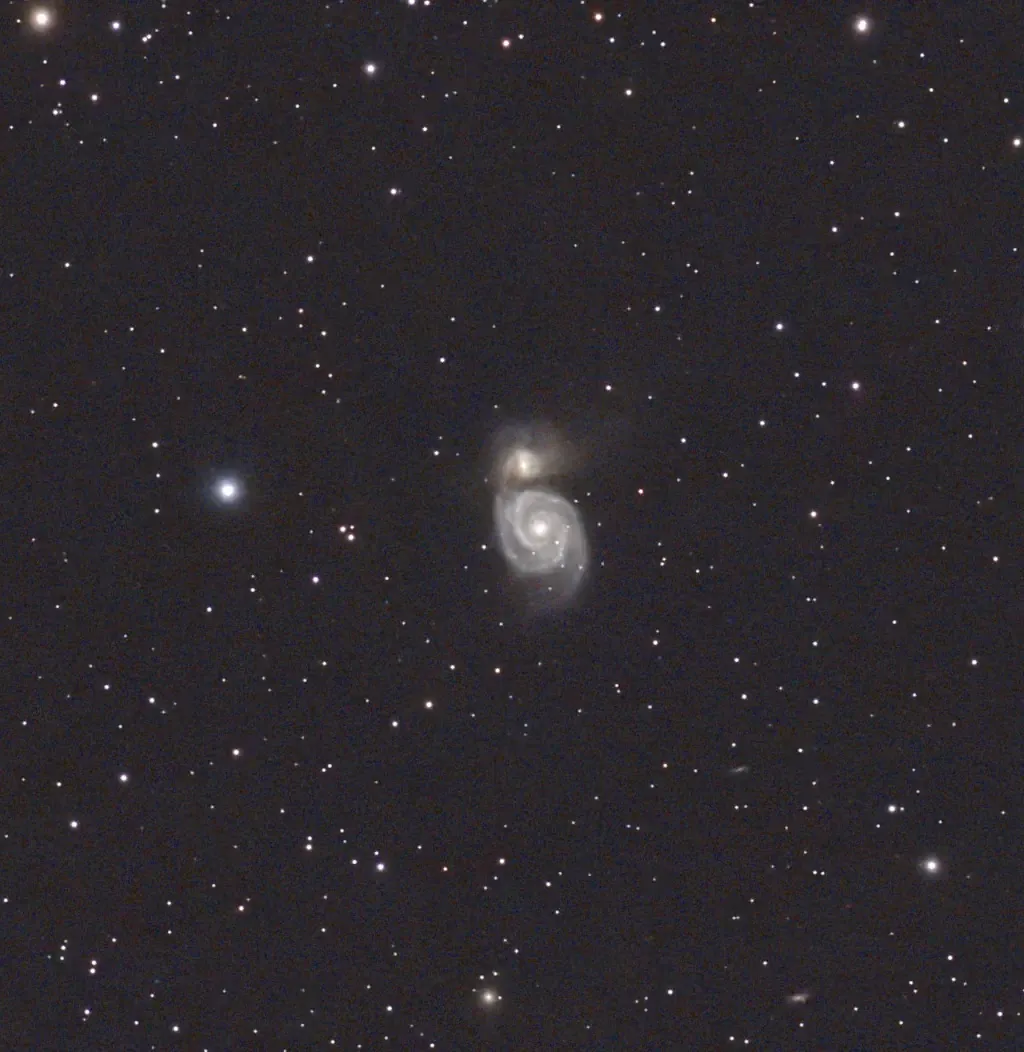
This has a companion galaxy, NGC5195, which is pulling out one of the spiral arms. Look carefully and you can see several smaller, more distant galaxies at lower right.
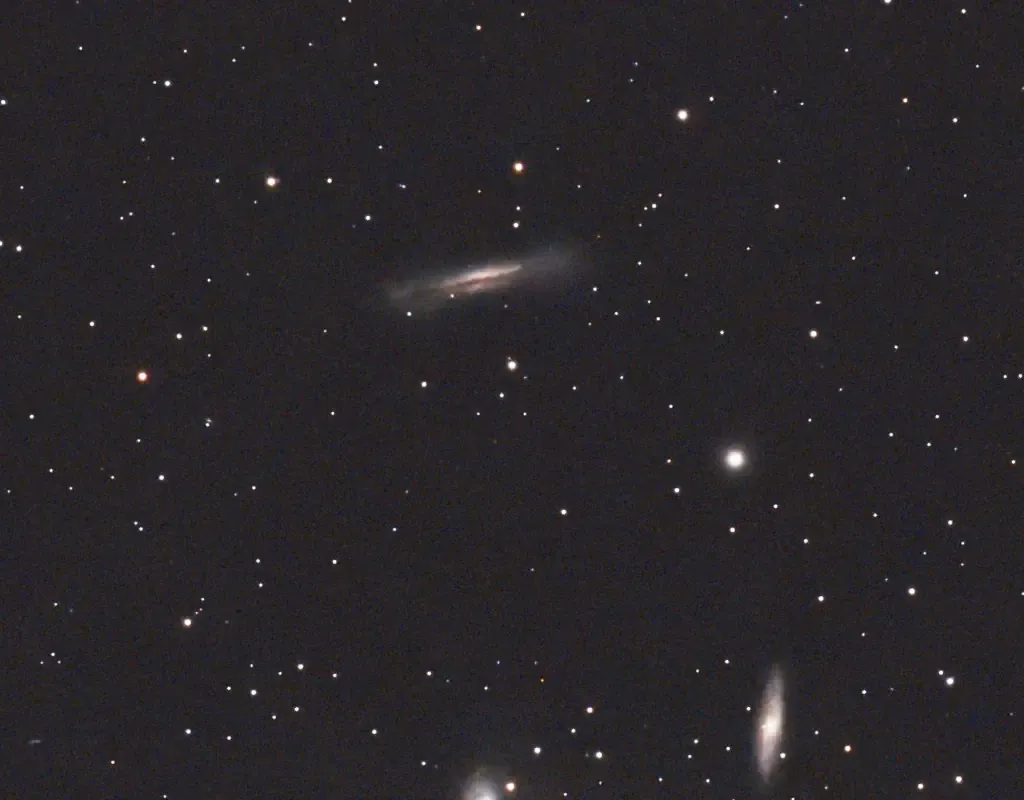
I also did the Hamburger galaxy, but I was jinxed again, this time by light pollution from our bathroom window.
[Update 20 Mar 2026]
Managed to get the Hamburger last night, although there was a lot of high cloud/haze. 100 shots, 30sec, gain 60:
Gradgrind Update
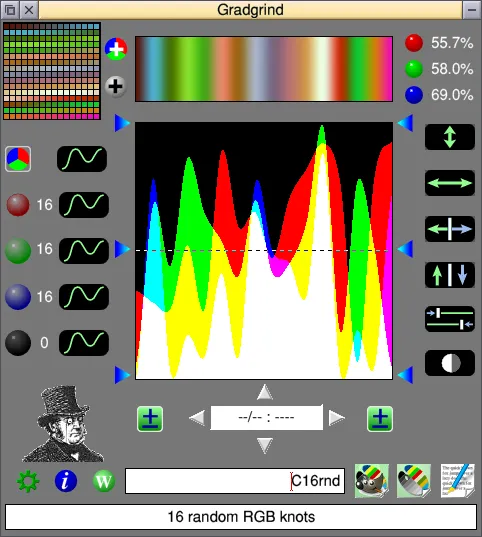
Gradgrind has been updated to 0.93beta. Changes:
- GIMP palettes changes:
- Doesn’t now ignore duplicates
- Added paged display for large palettes (uses left/right arrows)
- Description for these shows currently displayed colour numbers
- Includes (commented) description when saving as gpl file
- Added some sample GIMP palettes
- Sprite save icon removed. Can now drag the gradient/swatches displays to save them as sprites. Filename has “S” or “G” appended.
- Tidied up swatches display, and added option for outlines (toggle with ADJUST)
Galaxy Quest
Yesterday was Pi Day (March 14, 3.14), and at last we had a reasonably clear sky giving me a chance to try out an equatorial mount for the Dwarf Mini and so use slightly longer exposures. The seeing was marred somewhat by occasional bands of high cirrus, but I did manage to image some galaxies and a star cluster. But first, some notes on mounts.
The Dwarf Mini is motorised on two axes: it can spin round arbitrarily through the vertical axis, and modify the elevation by up to 225°. Placing the scope on a flat surface gives you an alt-azimuth mount, where, to compensate for the Earth’s rotation, it will have to slowly rotate through both axes. The disadvantage here is field rotation — objects at the edges of the image will slowly rotate, resulting in ‘trails’ for any stars. The Mini can compensate for this to some degree (hah!), but it does limit the length of single exposures to 15 seconds.
Alternatively, you can set up the scope on a tripod and set the vertical axis so it’s parallel to the Earth’s axis of rotation — this is an equatorial mount. In other words, point it at Polaris, the pole star (or just offset, to be accurate). This means that only one axis needs to rotate to match the Earth’s spin, and avoids any problem with field rotation. The maximum single exposure then goes up to 180 seconds.
To set up for an eq mount, attach the Mini (securely!) to the tripod — it has a standard screw fitting on the bottom — and ensure the tripod’s mounting plate is level; fortunately, our tripod (a Manfrotto) has a built-in spirit level.
Next, power up the Mini and connect to the app. Select Deep Sky, and use the 3-dot menu icon on the left to select EQ Mode. The scope will then walk you through the steps needed to align it correctly. Note that the pole star doesn’t have to be actually visible for this to work! It will examine the star pattern and work out where it’s pointing, then give instructions like “rotate the tripod head clockwise by about 9°” and “tilt it downward by 3°”, with helpful illustrations. It’s very easy to do, and only takes a few minutes.
I started the session with a look at the colourful Praesepe or Beehive star cluster in Cancer, aka M42:
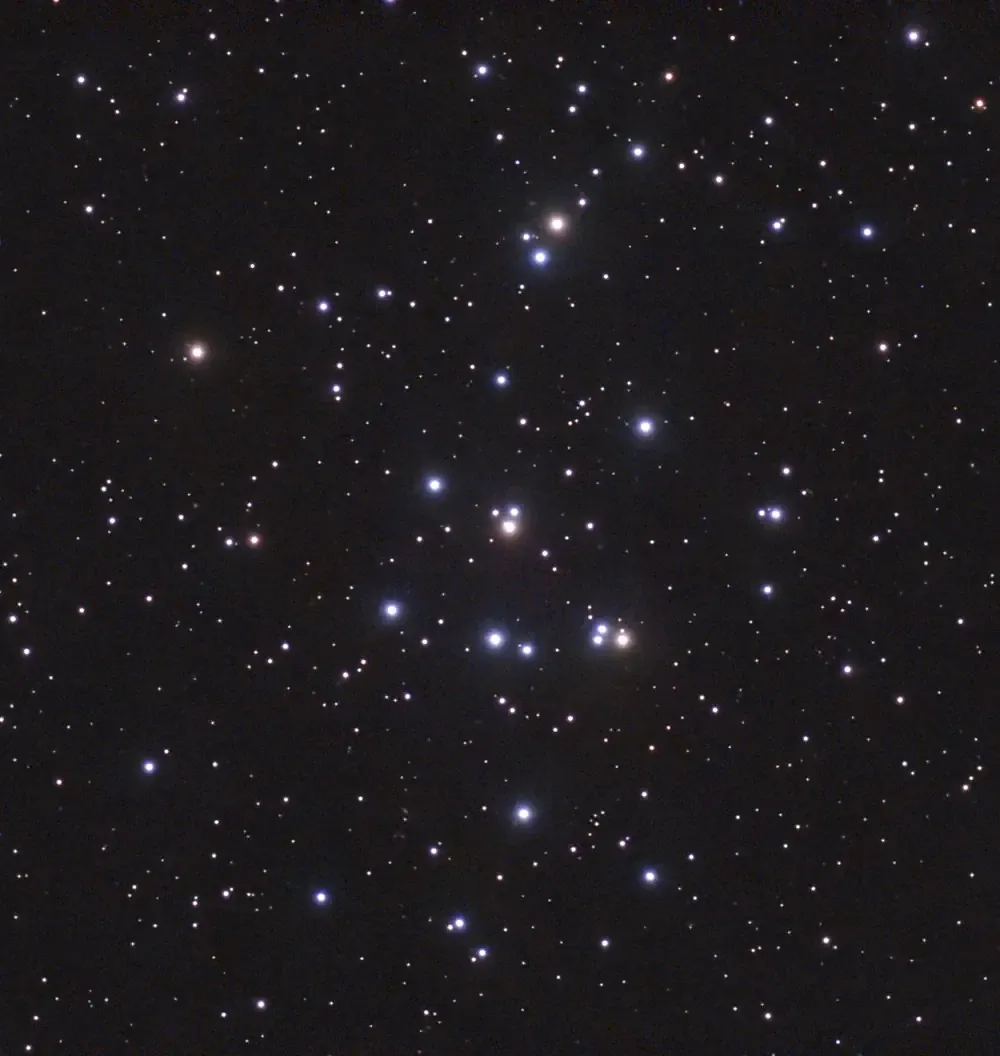
I took 50 images, with only one failure. They were 30-second exposures with gain 90. No processing here, but it’s been cropped (all image adjustments were done in PhotoDesk).
Next up, the Pinwheel galaxy in Ursa Major, aka M101:
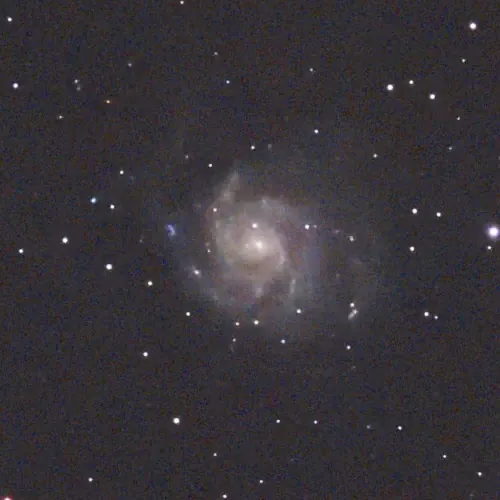
50 30-second exposures again. Cropped, and equalised and gamma boosted a bit. This suffered from the high cirrus problem (hence the noisy image and the slightly blurred stars), and would benefit a lot from more exposures.
Here’s Bode’s galaxy, M81 in Ursa Major, with M82 at lower left:
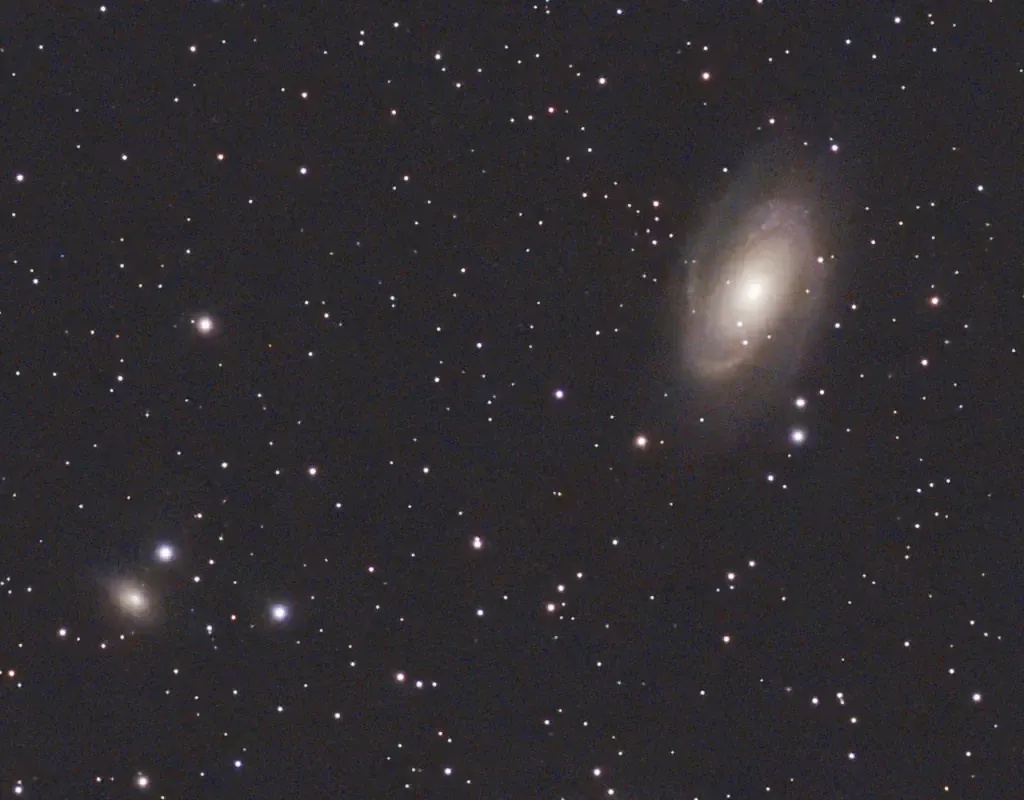
50 30-second exposures with one failure. Cropped, and a small equalisation.
Lastly, a bit of a failure due to cloud cover — I had to abort this one after only 18 shots. It’s NGC 3628, aka the Hamburger galaxy in Leo (at the top):
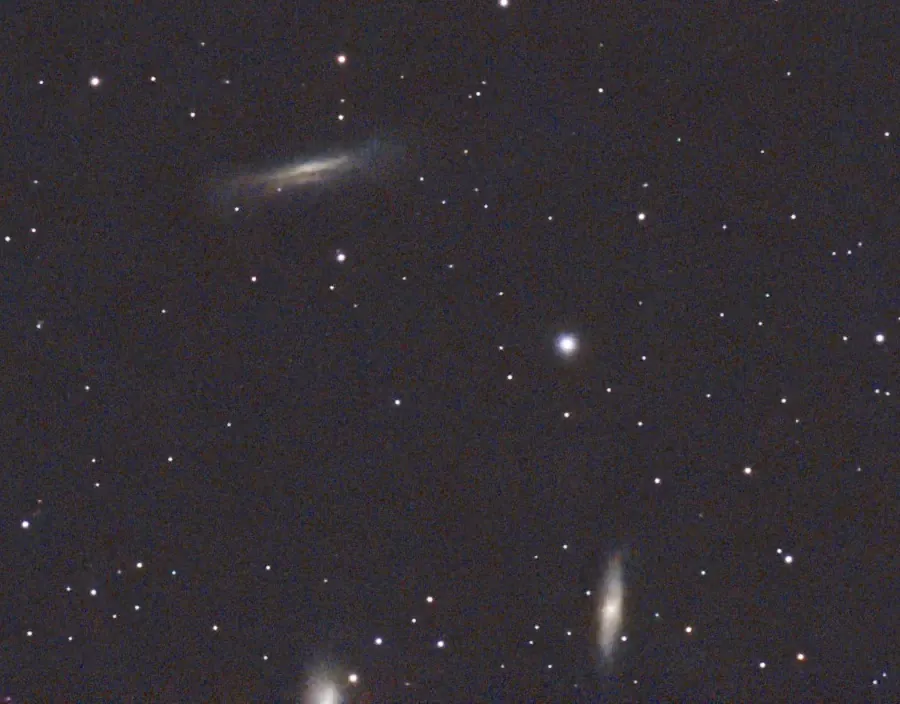
Cropped, and some gamma adjustment to bring out the colour. If I’d realised there were some other galaxies nearby (they’re the Leo Triplet) I would have re-centred to include them. Next time…
More on the Dwarf Mini and RISC OS
The weather continues very poor, with very few clear skies for astronomy. But I have managed to take a few pictures with the Dwarf Mini, and investigate some simple processing with PhotoDesk.
First though, a few more details on the scope and its usage. It’s controlled from a smartphone or tablet, and when it’s connected the display looks like this:
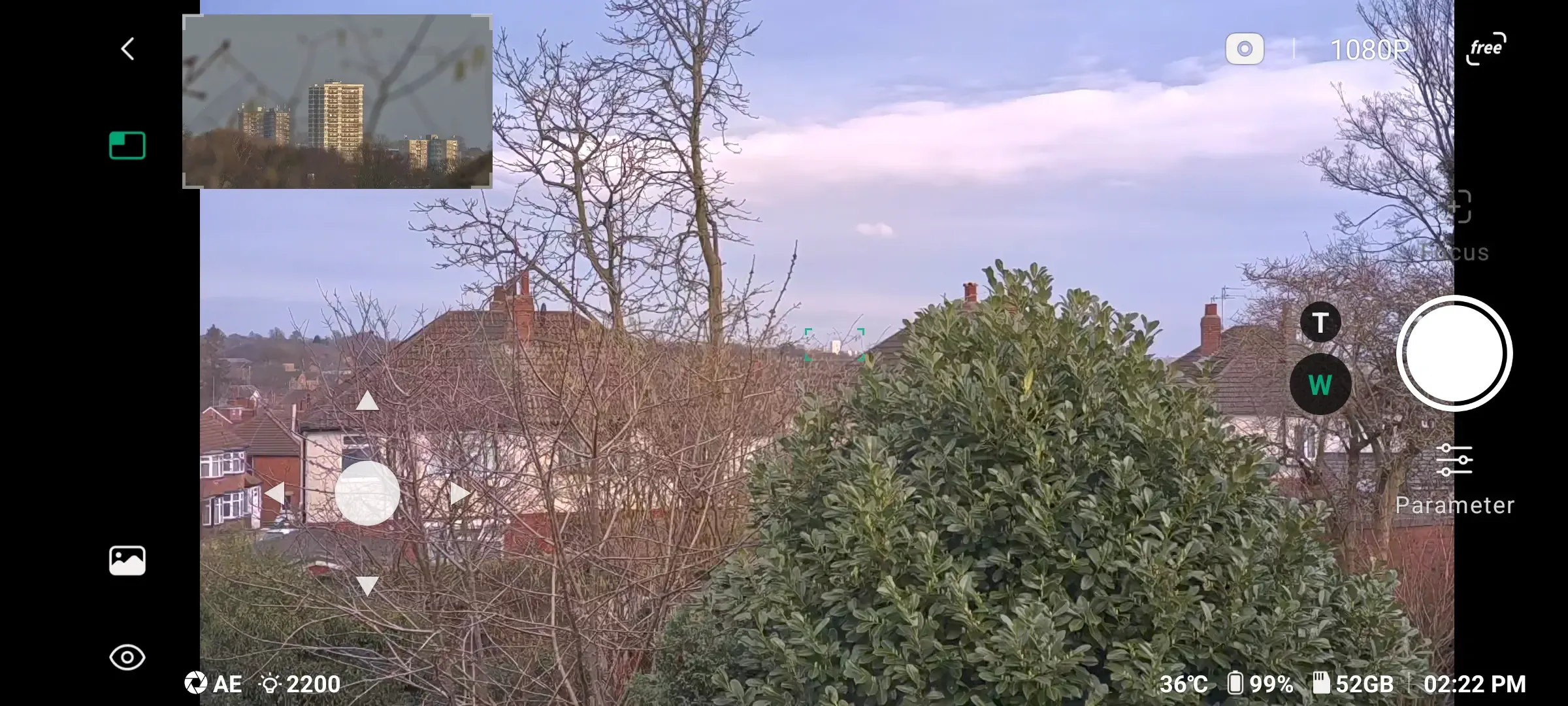
This is just a view out of our office window, to show the features. At top left, the inset image is the view through the telephoto lens, which shows the area outlined in green in the centre of the main display — here looking at a distant tower block. You can turn off this inset image by touching the green rectangle next to it.
[Read more…]
ROCoding #3: Ellipses and rings
The previous post in this series covered circular or radial blends and gradients. With a few simple modifications the code can be adapted to create elliptical and annular fills. Or eggs and doughnuts, if you prefer 😉.
Again, all these examples will be using various procedures from the previous posts.
RISC OS provides some graphics primitives to draw ellipses, and from BASIC this is:
ELLIPSE [FILL] centreX,centreY, width,height [, angle]
We won’t be using this however, and we won’t be including the angle setting, which draws a rotated ellipse. Let’s not make it too complicated…
[Read more…]
Dwarf Mini and RISC OS

The Dwarf Mini is an ultra-portable “smart telescope”, suitable for photographing deep-sky objects like nebulae and galaxies. It can also be used to image the sun and moon, but isn’t suitable for planetary imaging as the magnification is too small. It’s also useful for terrestrial imaging.
There is no eyepiece — you don’t look through it — and all operations are controlled via a tablet or smartphone, in our case a Pixel 6a. It’s motorised and can track astronomical objects automatically, either by just plonking it down on a flat surface or, for more accuracy in longer exposures, setting up an equatorial mount: just attach it to a tripod and align the scope to the pole star. There are built-in filters for deep-sky objects, a magnetically attached solar filter, and the device can take many images and stack them to increase the quality.
There are two cameras, wide-field and telephoto. The scope communicates with your phone using NFC, Bluetooth or wifi, giving a live display. The wifi can connect over your home LAN or directly, using its own server. All operations are controlled remotely, so (given adequate wifi range) you can do an observing session from inside your own home — a distinct advantage on cold winter nights. There’s a built-in comprehensive sky atlas and the app has a help system, and there’s a full manual online, also available as a PDF.
An example

So what do the images look like? We’ve had terrible weather recently, but today was our first clear day for ages. And here’s the sun at 8:30 this morning.
There are three small sunspots visible, confirmed via the SpaceWeather site. It’s a stack of 20 photos, each with 1/200sec exposure. Tracking was perfect — all I needed to do was point it at the sun and the rest was automatic.

And just to show it can do more, here are some starlings, photographed a few hours later. All shots were taken through an open window.
Accessing the files
While the phone is connected to the Mini, you can download the final stacked image to your phone as a standard JPEG, and then transfer it to your NAS or computer for perusal and editing. But to access the full uncompressed data — which consists of a number of raw images in FITS or TIFF format along with shooting data, calibration images and a PNG file of the stacked result — you need a different connection.
The manual for the scope claims that you can access the full images via a USB C-C cable, also used for charging the scope’s battery. But I’ve not been able to get that to work with any of our devices/computers — for example, if we plug the scope into our phone using the supplied cable it just starts charging the scope’s battery from the phone. I’m not alone in this; a number of other users report the same problem.
Fortunately, the Dwarf Mini has a built-in wifi server, and this method works perfectly, giving access to the full data over FTP. And RISC OS will happily connect to it so you can download images:

- Power on the Dwarf Mini
- Wait until the Mini’s indicator is a circling green light
- On RISC OS, select the device from wifi networks
- Enter the wifi password (the default is in the manual)
- Wait until the iconbar connection icon is green
- Now you can use FTPc to connect:
Host: 192.168.88.1
Security: 0 - None…
Passive: On
Add this connection to FTPc’s user menu with an appropriate name. For reference, I’m using a 4te2 running RISC OS 5.31.
Once you’re connected, you should see see a filer-like display, as right. You can navigate this like a filer window and copy files by drag-and-drop.
Note that my main internet connection is via an ethernet cable. This operates concurrently with the wifi, so I’m able to copy files straight over to our NAS. Also note that if the scope isn’t connected to a phone, it will power down after 10 minutes or so — the ftp connection does not override this.
The Astronomy directory will contain a number of subdirectories containing the actual data. The names of these contain useful information — for instance, the data for the sun picture above is inside:
DWARF_RAW_TELE_Sun_EXP_0.005_GAIN_10_2026-02-14-08-36-33-624
This tells you which lens was used (TELE), the target (Sun), the exposure times (0.005sec), the gain used (10 — this is roughly like the ISO setting in a camera), and the date and time (YYYY-MM-DD-hh-mm-ss-mss). It’s unfortunate that FTPc’s display can’t be made wider; you have to navigate the menu to Info to see the full name.
Inside the directory there’ll be a number of files like this:
Sun_0.005s10_Astro_20260214-083640954_25C.fits
…which is a FITS file. Again, there’s useful information here: the target (Sun), exposure time (0.005sec), the gain (10), the internal filter in use (Astro), and the date and time (YYYYMMDD-hhmmssmss). And lastly, 25C is the sensor temperature.
There’ll also be a file called shotsinfo.json, which can be opened as a text file:
{
    ”DEC”: 0.0,
    ”RA”: 0.0,
    ”binning”: ”1*1”,
    ”exp”: ”1/200”,
    ”format”: ”FITS”,
    ”gain”: 10,
    ”ir”: ”Astro”,
    ”maxTemp”: 25,
    ”minTemp”: 25,
    ”shotsStacked”: 20,
    ”shotsTaken”: 20,
    ”shotsToTake”: 20,
    ”target”: ”Sun”
}
DEC and RA are the celestial coordinates of the target. For the sun and moon this is not set, as the device tracks the target using the image itself, rather than knowing its position in the sky. For other objects, when you request a target the scope will analyse the star pattern it sees, and work out exactly where in the sky it’s pointing — an impressive process known as plate solving. The scope can then slew to the target’s position.
The stacked.jpg file is the one you can access on the phone, and there are also stacked versions as a 16-bit png and a 16-bit FITS file.
If you look at one of the FITS files in a text editor (double-click and hold), there’s a header like this:
SIMPLE  =                    T / file does conform to FITS standard
BITPIX  =                   16 / number of bits per data pixel
NAXIS   =                    2 / number of data axes
NAXIS1  =                 1280 / length of data axis 1
NAXIS2  =                  720 / length of data axis 2
EXTEND  =                    T / FITS dataset may contain extensions
BZERO   =                32768 / offset data range to that of unsigned short
BSCALE  =                    1 / default scaling factor
DATE-OBS= ’2026-02-14T08:36:40.944′ / Time end of exposure
EXPTIME =                0.005 / [s] Exposure Time
GAIN    =                   10 / Gain
RESTACK =                    0 / is Mega Stack
XBINNING=                    1 / binning factor used on X axis
YBINNING=                    1 / binning factor used on Y axis
FILTER  = ’Astro   ’           / selected filter
CAMERA  = ’TELE    ’           / shooting camera
XPIXSZ  =                  2.9 / [um] pixel size in microns (with binning)
YPIXSZ  =                  2.9 / [um] pixel size in microns (with binning)
FOCALLEN=                 150. / [mm] Focal length of telescope in mm
DET-TEMP=                   25 / Detector temperature in C
RA      =                   0. / [deg] Observe object RA coordinate (J2000)
DEC     =                   0. / [deg] Observe object DEC coordinate (J2000)
OBJECT  = ’Sun     ’           / Observe object
BAYERPAT= ’RGGB    ’           / Bayer pattern
EQMODE  =                    0 / Equatorial mode
FIRMWARE= ’1.0.22.1′           / telescope firmware version
MACADDR = ’xxxxxxxxxxxx’       / telescope MAC address
TELESCOP= ’DWARF mini’         / DWARFLAB telescope
INSTRUME= ’DWARF mini’         / DWARFLAB instrument
ORIGIN  = ’DWARFLAB’           / DWARFLAB TEAM
END
Solar and lunar photography has a resolution of 1280×720, while everything else is 1920×1080. The raw data is 16-bit graphics — just to be clear, that’s 16-bits per channel. And here’s where RISC OS will have problems: there is little software that can process 16-bit graphics files.
PhotoDesk will load the 16-bit PNG. I haven’t played around much, but on a star field image, the Increase contrast setting of Image processing>Gamma does a good job of reducing colour noise.
ChangeFSI can sort-of handle FITS files. But with limitations: you’re losing data (and low-level light data is very important in astronomical imaging), and you’ll get a greenish tinge which needs to be processed out. This is due to the RGGB Bayer pattern of the detector, which is quite standard.
I’ll be investigating this further, and will report on results here. Let’s hope for … clear skies! Which we had briefly last night, enough to get a first attempt at a random star field:

Well, I say random — it’s actually centred on the star HIP 80364, which, if you google it, turns out to be a star in the game Elite: Dangerous. So, a RISC OS connection…
ROCoding #2: Circles
The first post in this series covered filling a rectangle with blends and gradients. This time we’ll look at generating circular or radial blends and gradients, which is a bit more complicated. All these examples will be using various procedures from the previous post.
RISC OS provides graphics primitives to draw outline and filled circles. From BASIC:
 |
PROCinit SYS CT_SetGCOL%,&40dd4000 CIRCLE 64,192,60 CIRCLE FILL 192,64,60 |
The parameters are the centre coordinates and the radius, in OS units. As an aside, here’s the additive RGB triplet as used in the PhotoDesk manual, showing the complementary cyan, magenta and yellow colours. The circles are blended with the OR operation:
 |
PROCinit SYS CT_SetGCOL%,red% CIRCLE FILL 128,160,80 SYS CT_SetGCOL%,blue%,,,,1 CIRCLE FILL 170,88,80 SYS CT_SetGCOL%,green%,,,,1 CIRCLE FILL 92,88,80 |
So, can we use these primitives to create a radial blend? Here’s a first attempt:
[Read more…]
ROCoding #1: Rectangles
Coming back to RISC OS has been interesting. I’ve had to re-learn a number of things, like using the WIMP and, in particular, graphics programming. I hope this article will be the first of a series explaining my learning curve, and hopefully providing some useful programs. It’s fairly basic — in all senses! — but does assume some familiarity with RISC OS and BBC BASIC.
We’ll start with some things you can do when drawing rectangles. While writing the Solar application I wanted to provide some better backgrounds for the graphs. A plain background is easy, of course: just use RECTANGLE FILL with some appropriate colour, like this.
 |
GCOL 0,&ff,&dd,&ff RECTANGLE FILL 0,0,256 |
…which draws a 256×256 square at the graphics origin. More generally, RECTANGLE accepts both width and height, which can be negative.
First up, we’ll generate a blend between two colours, from the bottom to the top of the rectangle. We’re assuming a full-colour display here, which is necessary for displaying blends with any fidelity. The Solar application graphs are built up by redirecting all graphics output to a sprite, then letting the Wimp handle displaying them on screen; this takes care of any mismatch between the screen and graph colour depths.
[Read more…]
BASIC 5 vs BASIC64 [updated]
[Updated 5 Dec 2025. Now includes BASIC FPA timings, and text updated. DIV is now included.]
While writing the Gradgrind program (qv) I wondered if it would benefit from running under BASIC64 (or VI), as opposed to BASIC 5 (V). So I ran up a few simple speed tests (and they are simple — don’t take the results as definitive benchmarks). Although the program runs acceptably fast on my setup (a 4té2, which is based on a Pi 4b), it uses a fair amount of real arithmetic. The chief difference between the two versions is that BASIC 5 stores reals in 5 bytes, while BASIC64 uses 8 bytes. BASIC64 itself has two variants, VFP using the vector floating point operations available on the Pi’s ARM processor, and FPA using software floating point.
To use each variant:
- basic <file> Runs <file> using BASIC V. This is also the default setup for double-clicking a BASIC file.
- basic64 <file> Runs <file> under BASIC VI, which will select the VFP variant if available, otherwise uses FPA.
- basicvfp <file> Forces the VFP variant, if available.
- basicfpa <file> Forces the FPA variant.
The program to generate these results is available from the Downloads page.
System details:
R-Comp’s 4té2 (based on the Raspberry Pi 4b) running RISC OS 5.31 (21-Jul-24) at 1.5Ghz
BBC BASIC V 1.85 (03 Oct 2022)
BBC BASIC VI 1.85 (03 Oct 2022) VFP
BBC BASIC VI 1.85 (03 Oct 2022) FPA
Notes on the tests
- All tests were run in single-tasking mode (not in a task window).
- Each test (other than the WHILE/REPEAT ones) is enclosed in a FOR…NEXT loop, with the index variable running from 1 to 100,000,000. So they are run 100 million times. This was chosen so that an empty loop runs in about 1 second. Other than tests 3, 4 and 6, the index variable is an integer.
- The description specifies what operation is inside the loop.
- All timings are in seconds with centisecond resolution, other than the total time which is in minutes:seconds.
- The “Assignment a%=long…” tests are done because I often use systematic prefixes for variable names, and I wondered if having many variable names with identical prefixes would slow things up. The testing program defines 300 variables called “VeryLongVariableNameWithIncrementingSuffix001%” to “VeryLongVariableNameWithIncrementingSuffix300%”.
| Test | BASIC V | BASIC VI VFP | BASIC VI FPA |
|---|---|---|---|
| Empty FOR loop (int) | 0.97 | 1.02 | 0.98 |
| Empty FOR loop (int, no spaces) | 1.01 | 1.15 | 1.00 |
| Empty FOR loop (real) | 3.09 | 1.11 | 65.07 |
| Empty FOR loop (real, no spaces) | 3.10 | 1.10 | 65.05 |
| Empty FOR loop, NEXT I% (int) | 3.02 | 3.04 | 2.97 |
| Empty FOR loop, NEXT I (real) | 5.12 | 3.76 | 67.05 |
| Assignment A%=100 | 4.17 | 4.13 | 23.61 |
| Assignment a%=100 | 4.14 | 4.14 | 30.69 |
| Assignment a%=b% (100) | 4.39 | 4.39 | 23.63 |
| Assignment a=0.5 | 4.19 | 4.02 | 53.65 |
| Assignment a=b (0.5) | 4.89 | 3.82 | 53.78 |
| Assignment a%=Very…x001% | 4.38 | 4.39 | 23.63 |
| Assignment a%=Very…x300% | 4.39 | 4.39 | 23.62 |
| Integer maths a%=b%+c% (100+50) | 6.62 | 6.63 | 26.16 |
| Integer maths a%=b%-c% (100-50) | 6.62 | 6.63 | 26.26 |
| Integer maths a%=b%*c% (100*50) | 6.78 | 6.78 | 26.28 |
| Integer maths a%=b%/c% (100/50) | 16.47 | 8.44 | 181.51 |
| Integer maths a%=b%DIVc% (100DIV50) | 7.96 | 7.62 | 27.55 |
| Real maths a=b+c (0.5+0.2) | 7.93 | 5.85 | 154.60 |
| Real maths a=b-c (0.5-0.2) | 8.43 | 5.88 | 135.51 |
| Real maths a=b*c (0.5*0.2) | 7.90 | 5.85 | 134.98 |
| Real maths a=b/c (0.5/0.2) | 17.88 | 6.69 | 171.36 |
| Real maths a=b^c (0.5^0.2) | 46.09 | 90.33 | 1651.64 |
| Real maths a=SQRb (0.5) | 15.96 | 5.40 | 103.40 |
| Trig a=RADb (0.5) | 6.24 | 4.52 | 85.88 |
| Trig a=SINb (0.5) | 19.28 | 46.44 | 768.88 |
| Trig a=COSb (0.5) | 28.86 | 47.25 | 794.56 |
| Trig a=TANb (0.5) | 26.89 | 74.45 | 757.27 |
| WHILE loop (int, I%=I%+1) | 10.89 | 10.80 | 31.46 |
| WHILE loop (int, I%+=1) | 9.39 | 9.38 | 9.38 |
| REPEAT loop (int, I%=I%+1) | 11.58 | 11.16 | 32.17 |
| REPEAT loop (int, I%+=1) | 9.52 | 9.49 | 9.52 |
| Total (m:s) | 5:18 | 6:50 | 92:43 |
Takeaways
- BASIC VI FPA is slow. If you run the test program be prepared to cook and eat your dinner while it shuffles along. And possibly include a nap.
- I’m puzzled why integer operations under BASIC VI FPA are so slow; I wasn’t expecting these to vary much. Addition, subtraction, multiplication and the DIV operator are about 4 times slower than BASIC V. Using / to divide is even worse, 11 times slower. And even simple integer assignments are about 6 times slower.
- Note that using a real variable as the index in a FOR…NEXT loop in BASIC VI FPA is twenty times slower than BASIC V (and over sixty times slower than BASIC VI VFP).
- Don’t use variables after NEXT; it’s three times slower, and they’re very rarely needed. This can make a considerable difference for nested FOR loops.
- I’ve done both “A%=” and “a%=” assignments to check if so-called ‘resident integer variables’ (A% to Z%) still give a speed benefit. But it seems there’s no advantage now to using them.
Ancient history note: this feature dates back to the Acorn Atom (my first computer back in 1980 — I soldered it together!), when A-Z were the only variables you had (integer only); if you wanted more you had to use arrays (just AA to ZZ) or indirection. BBC BASIC evolved from Atom BASIC — indeed, you could get it on the Atom as an add-on board — and the resident integer variables on the BBC Micro’s original BASIC were a legacy. - The long variable name tests don’t appear to make much difference. But it turns out that both versions use a fairly sophisticated caching strategy for variable names, so this isn’t really a valid test. I’d be interested to know if the same strategy is used for procedure/function names (which I haven’t tested here).
- Integer maths is pretty much identical between BASIC V and BASIC VI VFP, with the exception of division which is twice as fast in BASIC VI VFP.
- Simple real maths is faster in BASIC VI VFP than BASIC V, by about 25-30%; again, division is twice as fast. It’s interesting that BASIC VI VFP’s real maths operations are slightly faster than their integer equivalents. Of course, different values may give a different result.
- Square root — a common operation — is three times faster in BASIC VI VFP.
- Avoid exponentiation if you can — it’s a very expensive operation, in all versions.
- I was a bit surprised that BASIC VI VFP’s trig functions weren’t better. Although they are, of course, much more accurate.
- Using += and -= to increment/decrement variables gives a small but useful speed increase, particularly under BASIC VI FPA.
Conclusion
No, it wouldn’t really be worth Gradgrind using BASIC VI VFP. For much of the real arithmetic involved I’ve used pre-calculation, and the speed increase would be minimal.
Downloads
Download the program from the Downloads page.