The Triangulum, Again
August 28. A near-total lunar eclipse should have been visible in the early hours, but when the alarm woke us up the sky was completely clouded over. And even the promised lightning display never turned up. Doh.
So here’s another go at processing the Triangulum Galaxy, M 33:
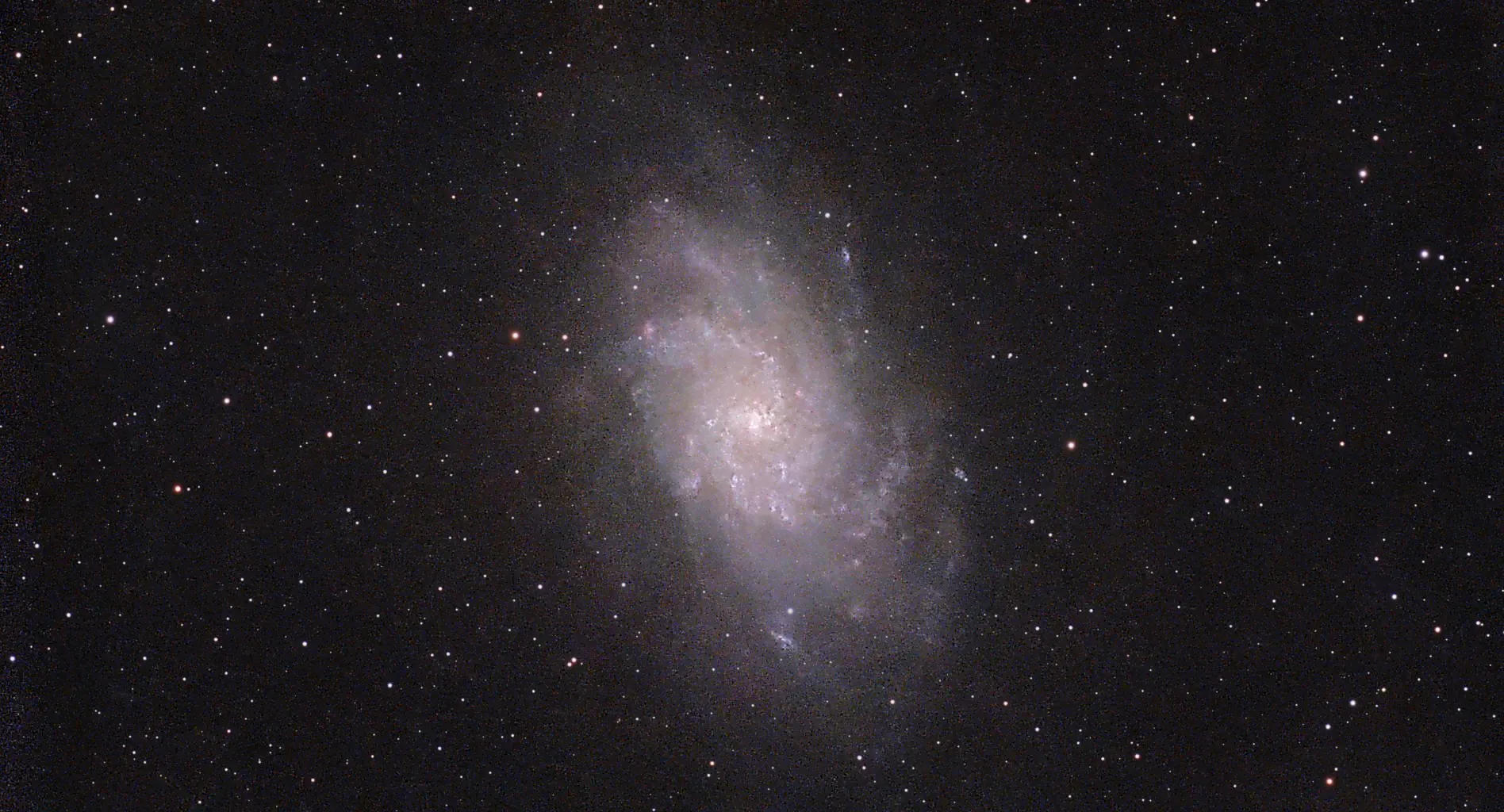
M 33 seems a rather hard target to process, given it’s one of the brightest and closest galaxies. Here I’ve tried unsharp-masking the Astro filtered images from August 14 (radius 2, contrast boost 300, threshold 2). It’s better, but there’s still a lack of detail.
Details:
Target: Triangulum Galaxy (M 33, NGC 598)
Equipment: Dwarf Mini, Astro filter, perfect EQ
Time: 2026-08-14 23:33-02:28
Integration: 2hrs 21mins (141×60secs, +19 failures), gain 60
Conditions: Clear, Bortle 6
Processing: PhotoDesk equalisation, unsharp mask
And so to bed…
An Iris
August 23, a very clear night (and it looks like the last for a while) with a flower.
This is C 4, the Iris Nebula in Cepheus:
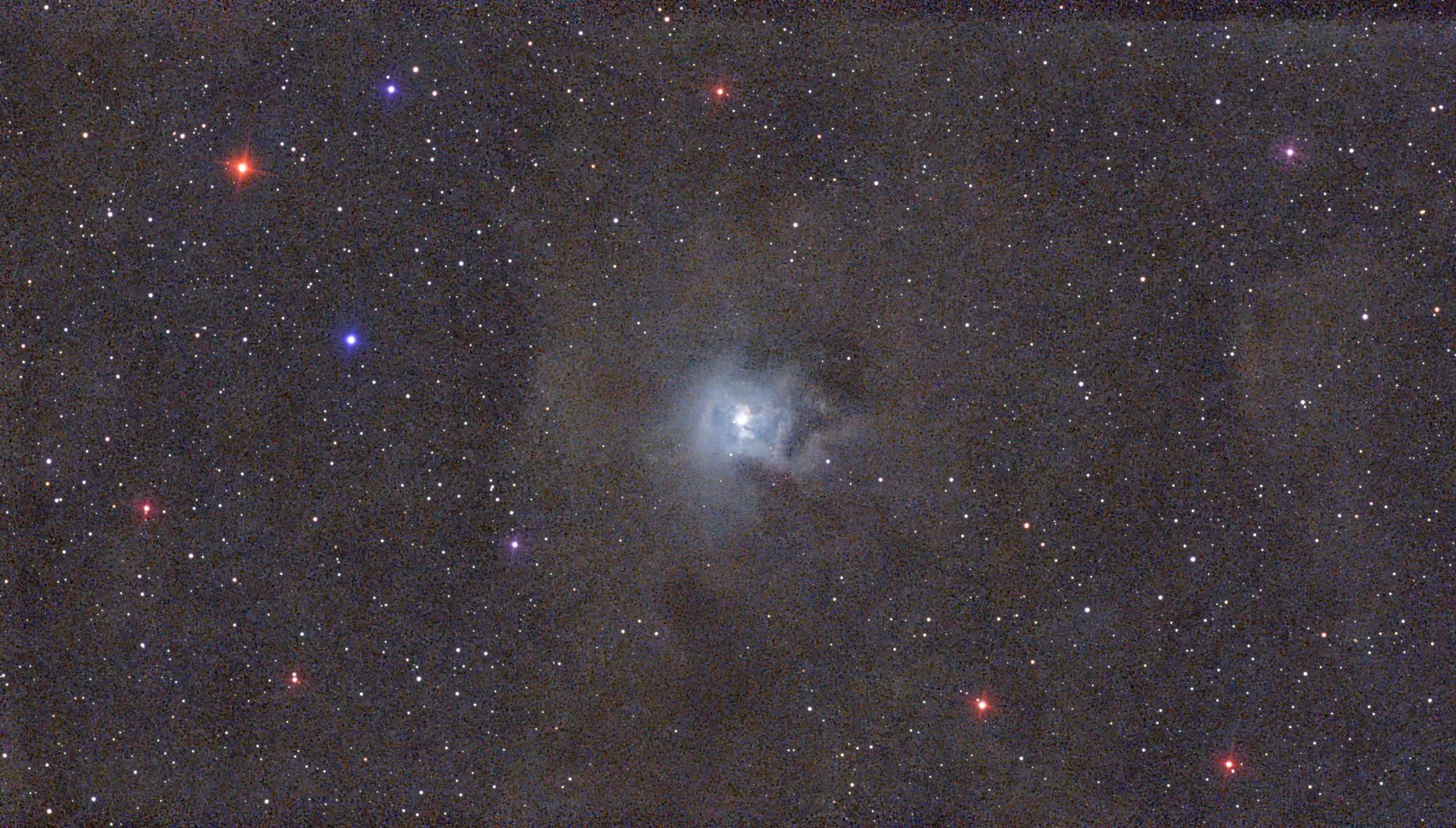
It’s a reflection nebula 1,300 light years away and 6 light years across, illuminated by the central star HD 200775.
Surrounding the bluish nebula are complex brownish clouds of interstellar material. These are of interest because they have been found to contain buckminsterfullerene, a large organic molecule consisting of 60 carbon atoms arranged in a sphere (it looks much like the panels in a football).
The surrounding clouds are faint and difficult to image, and more exposures would bring them out better.
The bright reddish star at top left is T Cephei, a very large red giant which would engulf the orbit of Mars if it was placed where the Sun is. It’s a Mira-class variable star with a period of 385 days, varying between magnitude 11.3 (invisible to the eye) and 5.2 (just visible) — here it’s about 7.3 and is approaching its next maximum brightness in November 2026.
Details:
Target: C 4 (Iris Nebula, NGC 7023)
Equipment: Dwarf Mini, Astro filter, perfect EQ
Time: 2026-08-23 21:25-23:57
Integration: 2hrs 18mins (138×60secs, +2 failures), gain 60
Conditions: Clear, Bortle 6
Processing: PhotoDesk equalisation, gamma, usm
And so to bed…
Pleiades, Improved
August 22. The sky cleared after 2am so I managed to catch the Pleiades again, and here’s a megastack of the two sessions:
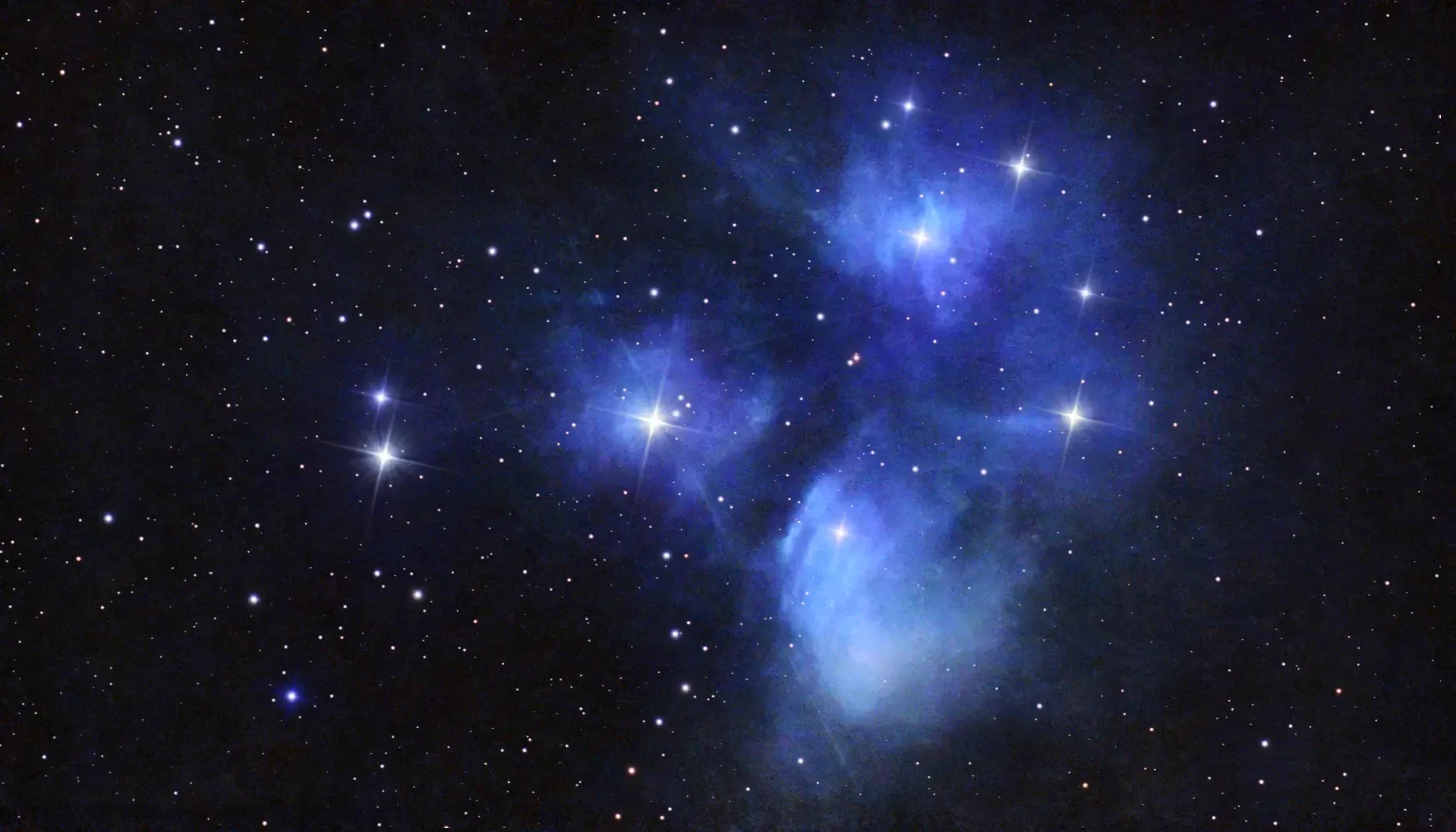
Much improved, particularly the nebulosity around Alcyone in the centre of the image. The Mini managed to miss a satellite trail passing through it though.
Details:
Target: M 45 (The Pleiades)
Megastack session 1:
Equipment: Dwarf Mini, Astro filter, perfect EQ
Time: 2026-08-15 02:35..04:16
Integration: 1hr 12mins (163×30secs, +5 failures), gain 40
Conditions: Clear; Bortle 6
Megastack session 2:
Equipment: Dwarf Mini, Astro filter, perfect EQ
Time: 2026-08-23 02:39..04:19
Integration: 1hr 12mins (164×30secs, +3 failures), gain 50
Conditions: Slightly hazy, clearing; Bortle 6
Total integration: 2hrs 24mins
Processing: PhotoDesk equalisation, gamma
And so to bed…
Stephan’s Quintet, and California Nebula
August 21. There’s been a run of cloudy nights recently, but despite a bad forecast for tonight it stayed clear until about 3am.
A new target first, and a hard one. The galaxy C 30 in Pegasus, and the nearby Stephan’s Quintet:
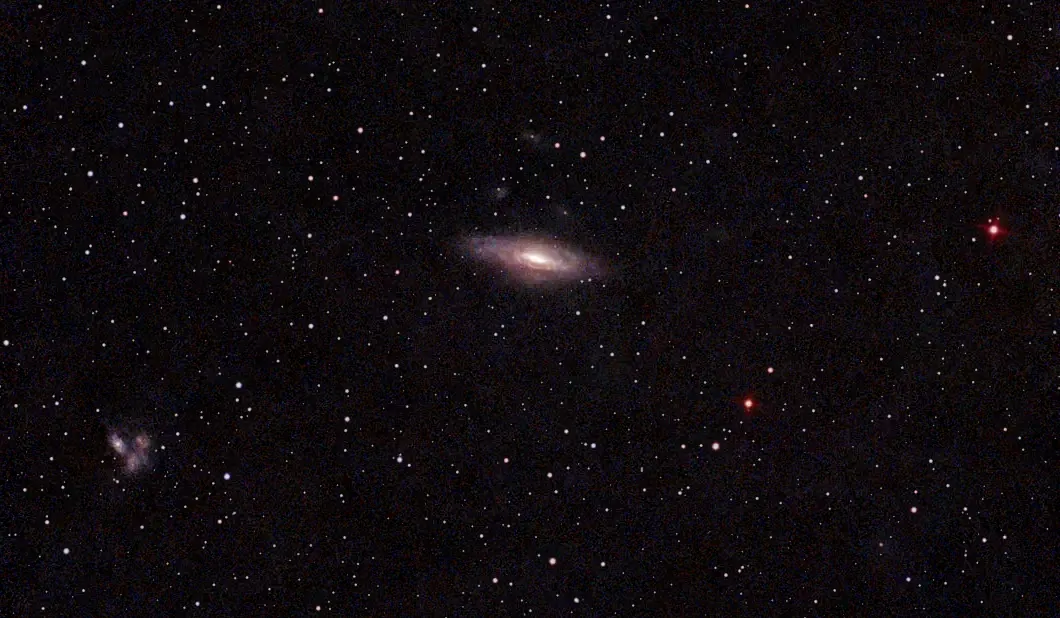
C 30 is an unbarred spiral galaxy, and unusually the bright core is rotating in the opposite direction to the main spiral arms. Faintly visible above it are some of the “fleas”, a group of unconnected and much more distant galaxies. It’s also known, oddly, as the Deer Lick Group, apparently after the Deerlick Gap in North Carolina — hence the “fleas” monicker, I imagine.
Stephan’s Quintet, a grouping of galaxies, is at lower left. It looks like three galaxies here — the lower one is actually a pair of interacting galaxies, while the fifth is very faint and just below the main group; it’s not really visible in this image, and anyway is not physically connected to the main grouping.
This target needs many more exposures and some extensive processing to bring out more detail.
Details:
Target: C 30 (NGC 7331)
Equipment: Dwarf Mini, Astro filter, perfect EQ
Time: 2026-08-21 21:36..01:08
Integration: 3hrs (180×60secs, +12 failures), gain 80
Conditions: Clear, Bortle 6
Processing: PhotoDesk equalisation, gamma, crop
Next up was a first go at the California Nebula:
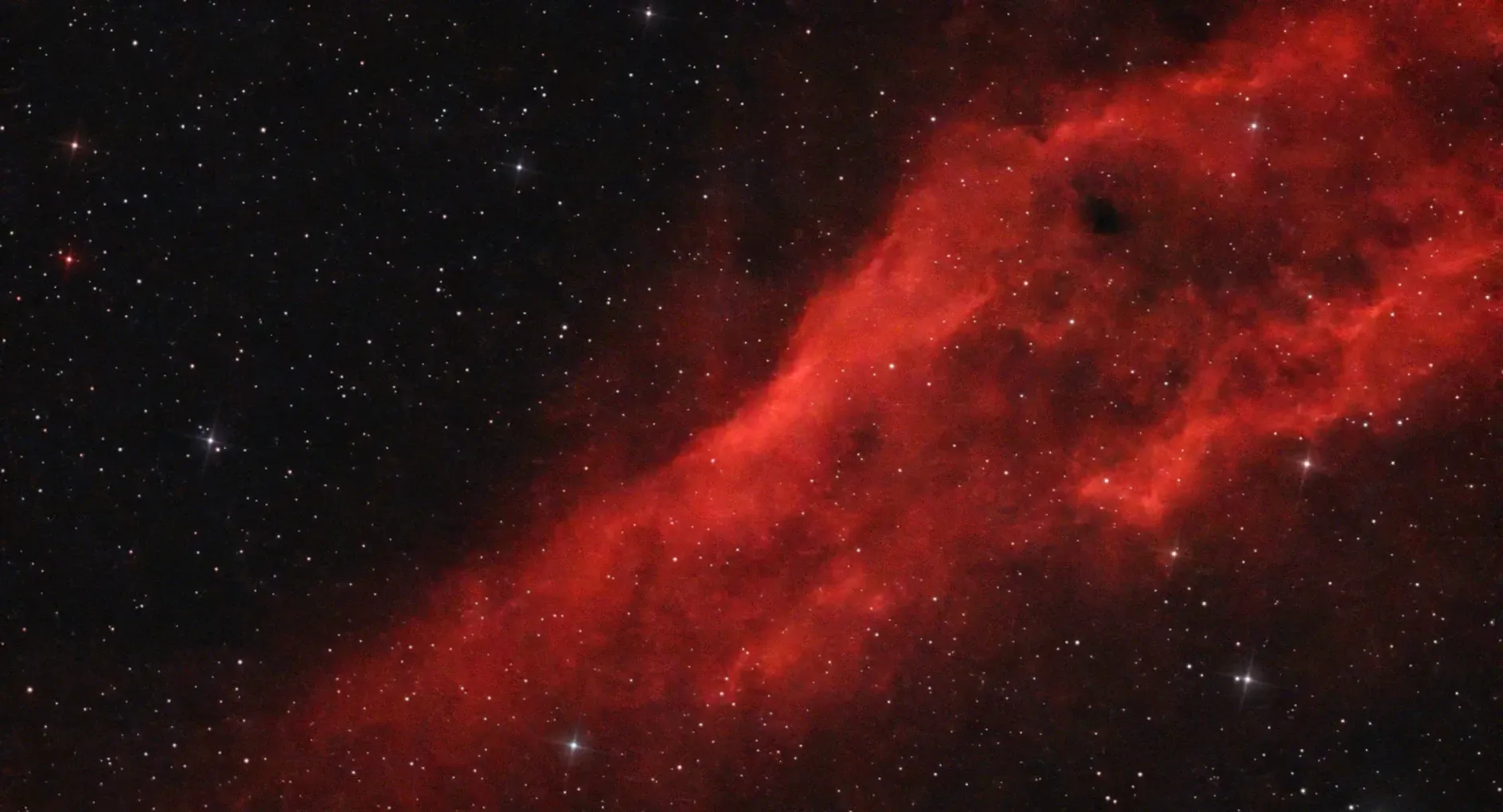
Does it look much like California? Well, perhaps … it looks more like the head of a crocodile to me. Its official name is NGC 1499, and it’s an emission nebula in Perseus. The red H-alpha glow is caused by the highly energetic star Menkib, Xi Persei, just off-screen at bottom right.
Details:
Target: NGC 1499 (California Nebula)
Equipment: Dwarf Mini, Duo-Band filter, perfect EQ
Time: 2026-08-22 01:27..02:20
Integration: 50mins (50×60secs, no failures), gain 80
Conditions: Clear, Bortle 6
Processing: PhotoDesk equalisation, gamma
Finally I tried the Pleiades again, but unfortunately the clouds started moving in so the shoot was abandoned.
And so to bed…
Seven Sisters
August 14, and the end of the heat at last. A clear night, and the first proper chance to have another go at the Pleiades, now becoming visible in the early hours.
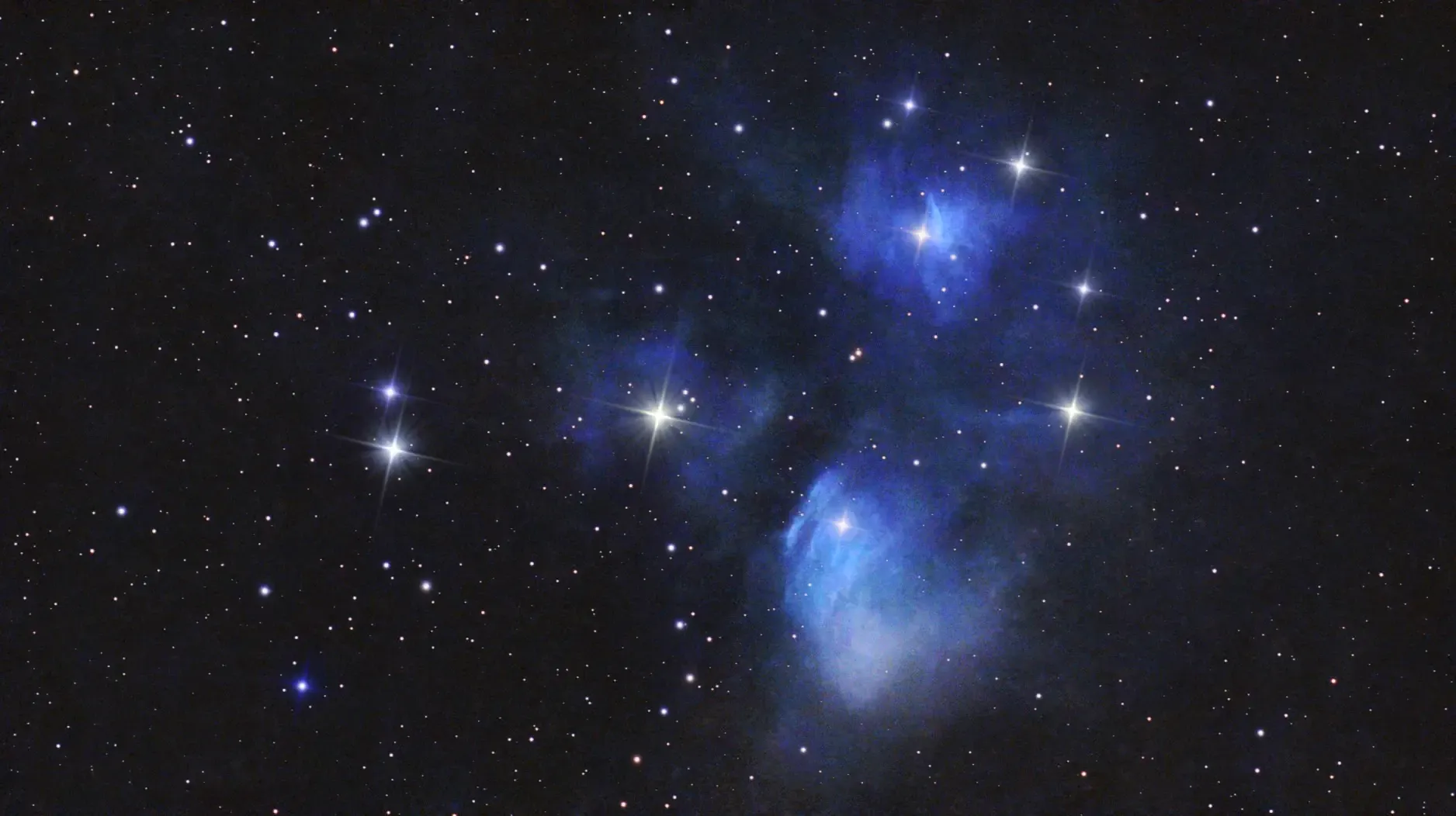
A much better result than the first effort back in March, when it was on the other side of the sky and I had a street light to deal with.
Imaging the Pleiades poses some problems. The main stars are very bright and the nebulosity is pretty faint. You have to balance exposure time and gain so that the stars don’t get blown out, while still capturing the nebulosity; here I used 30-second exposures with a lowish gain of 40. And a clear sky helps – any haze will cause the stars to bloom.
Details:
Target: The Pleiades (M 45)
Equipment: Dwarf Mini, Astro filter, perfect EQ
Time: 2026-08-15 02:35..04:16
Integration: 1hr 12mins (163×30secs, +5 failures), gain 40
Conditions: Clear, Bortle 6
Processing: PhotoDesk equalisation, gamma
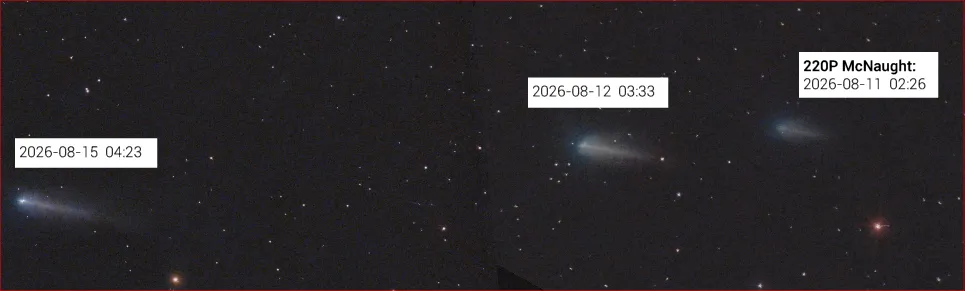
I also had another shot at Comet 220P/McNaught. So here are three days overlaid, showing the movement (13th was Perseids, and 14th was cloudy):
And so to bed…
A Big Day!
August 12, a big day for astronomy here. A solar eclipse, a meteor shower, various galaxies, and first up, Comet 220P/McNaught. This is an overlay of the images taken on 11 and 12 August, showing how much the comet has moved in 25 hours:
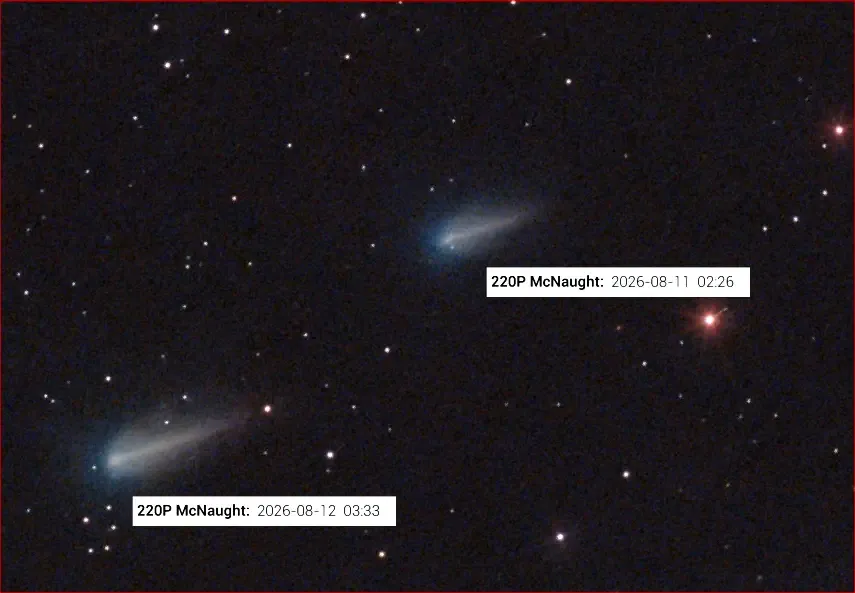
The times are of the first frame in each case. The comets themselves look a bit different because they had different exposures, gains and mounts (which meant one had to be rotated to align the stars).
Comet 220P/McNaught is periodic, and orbits between Mars and Jupiter every 5.5 years. It’s normally pretty faint at magnitude 17 (probably too faint for the Mini to image), but on 31 May and 5 August this year there were two outbursts when the comet was closest to the Sun. These increased the brightness by 8,000 times, to magnitude 7 or so.
And now, the partial solar eclipse. In Leeds this ran from 18:12 to 20:03, with the maximum coverage of 92% of the Sun at 19:09.
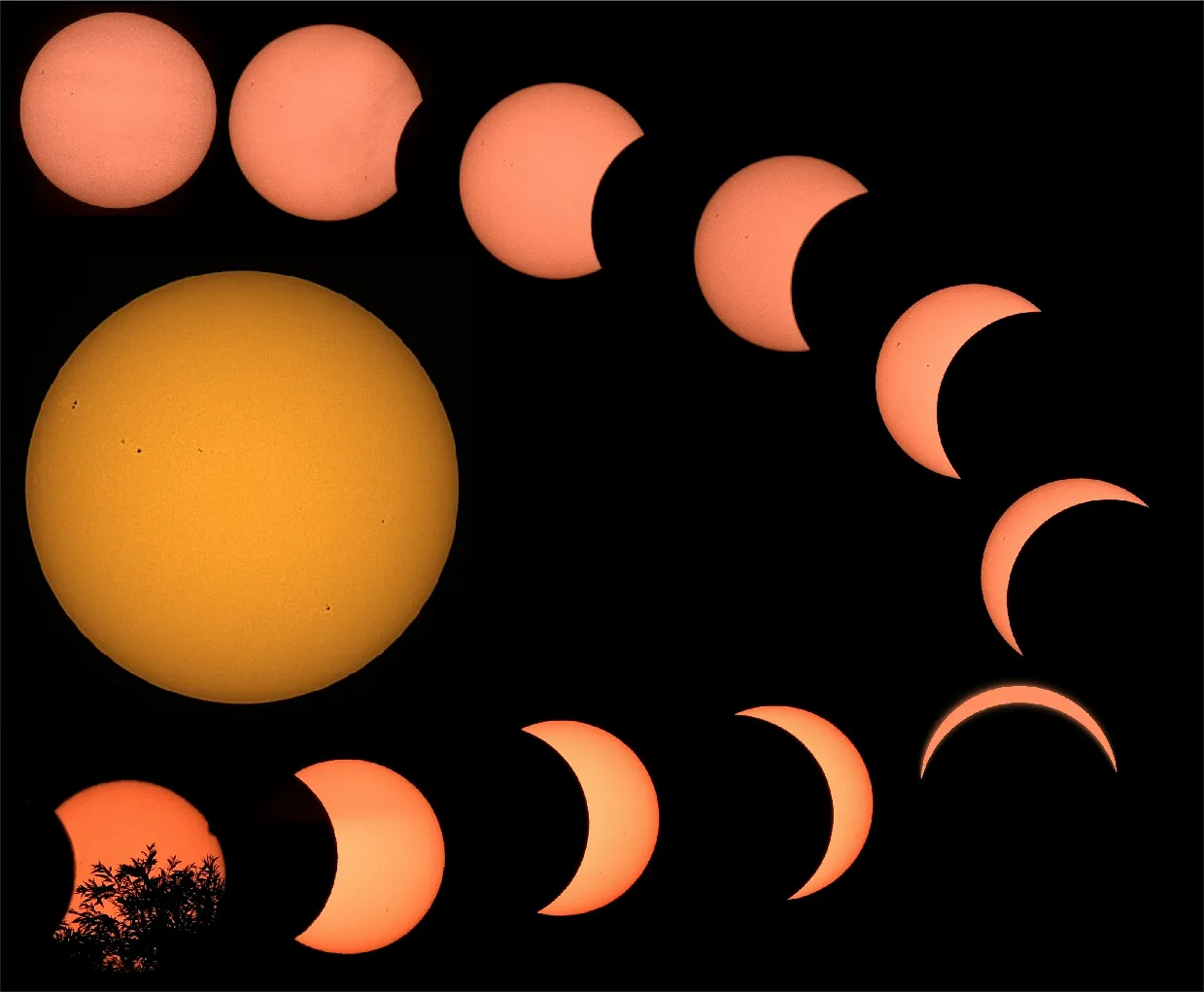
Here I’ve montaged a selection of the 430 pictures the Mini took, using its Burst mode of a photo every 15 seconds. As I couldn’t get off work I had to set the scope up on the roof of the library (with permission!) and set it running during my break.
The final montage image shows the Sun disappearing behind the roof garden of a local pub; I wasn’t able to get the last stages of the eclipse. The central image is a higher resolution picture of the Sun taken at quarter to six, just before the main shoot started. Sadly there are only a few small sunspots.
Here’s the video:
There were a couple of minor problems. The focus went a bit off at one point (probably due to the Mini running very hot at over 50°), but you can refocus during Burst mode so could be fixed; you can see this happening at about 8 seconds. And at about 19:15 I noticed that the Sun (still being eclipsed) was about to disappear behind a building, so I halted the shoot, moved the camera and restarted capturing. I only lost about 2 minutes, so not a disaster.
The video was built by ffmpeg from the 430 jpegs emitted by the Burst mode. Some images — only 4 — were badly tracked, so were replaced by adjacent photos. The whole sequence was then stabilised (using the incredibly capable ffmpeg again), and reduced to 800 pixels wide for displaying here.
Later was the maximum of the annual Perseids meteor shower. Here’s a star trails covering 4 hours from about 11:30:
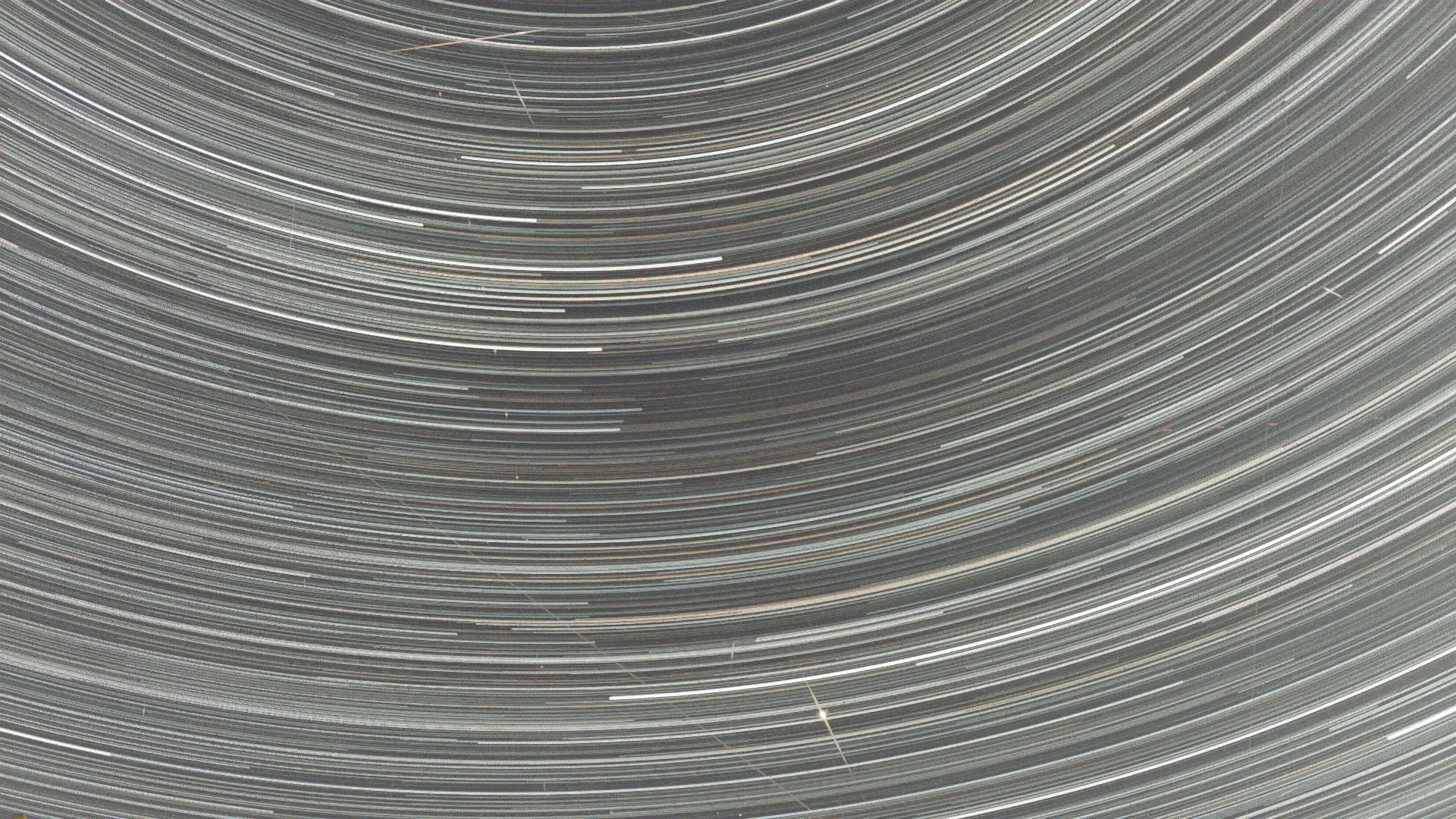
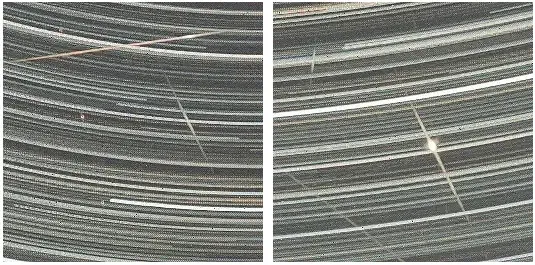
We caught a couple of Perseids, plus sporadics, aircraft and satellites. Here are a couple of close-ups of some of the meteors. The scope was pointing straight up.
You have to be lucky when photographing meteors. We did see a few more with naked-eye observation, but the camera wasn’t pointing at them. Oh well.
Galaxies next. I scheduled two shoots of the Triangulum Galaxy, one with the Astro filter and the other using the Duo Band filter to try to bring out the nebulosity. I then stacked them manually (not with the Mini’s Megastack facility) to get this:
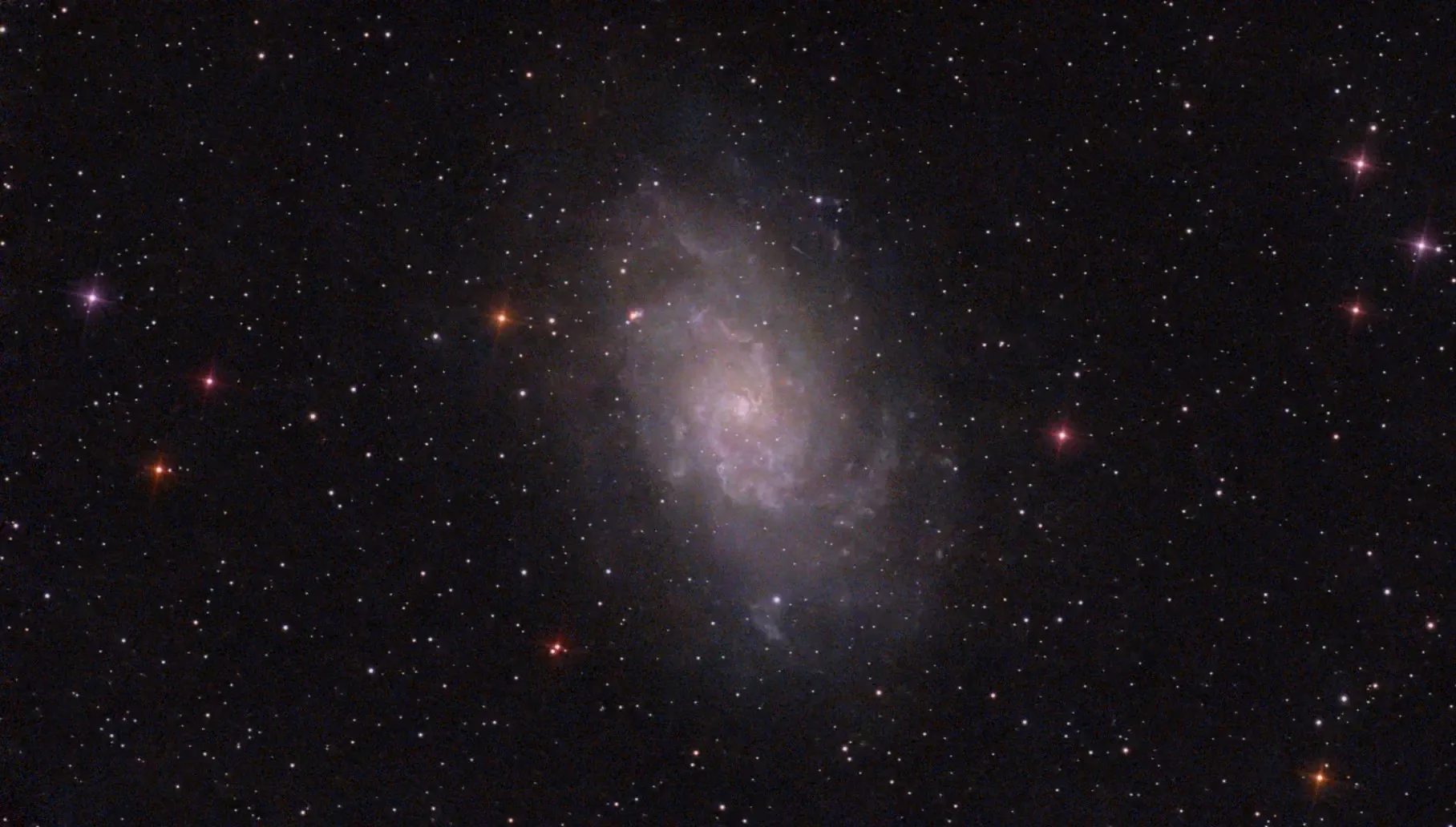
So a bit of an experiment. It clearly needs more exposures on the Duo Band, but it’s an improvement.
Details:
Target: Triangulum Galaxy (M 33, NGC 598)
Equipment: Dwarf Mini, Astro filter, 1% EQ
Time: 2026-08-12 00:39..02:01
Integration: 1hr 12mins (72×60secs, +4 failures), gain 70
Equipment: Dwarf Mini, Duo Band filter, 1% EQ
Time: 2026-08-12 02:09..03:20
Integration: 1hr 3mins (63×60secs, +3 failures), gain 70
Conditions: Clear, Bortle 6
Processing: PhotoDesk manual stack, equalisation, gamma
Finally, another addition to the megastack of M31, the Andromeda Galaxy:

Details continue to improve. The different colouration may be due to the Duo Band filter used on one of the stacks … actually I think I prefer the earlier effort.
Details:
Target: Andromeda Galaxy (M 31)
Equipment: Dwarf Mini, Astro filter, 1% EQ
Time: 2026-08-12 00:39..02:01
Integration: 1hr 33mins (93×60secs, +12 failures), gain 70
Megastacked with 4 other exposures
Conditions: Clear, Bortle 6
Processing: PhotoDesk equalisation, gamma
And so to bed…
Comet 220P/McNaught
August 10, and another comet. This is 220P/McNaught, a periodic comet which recently exploded and brightened enormously (see Aug 9 entry), from magnitude 17 up to 7 or so:
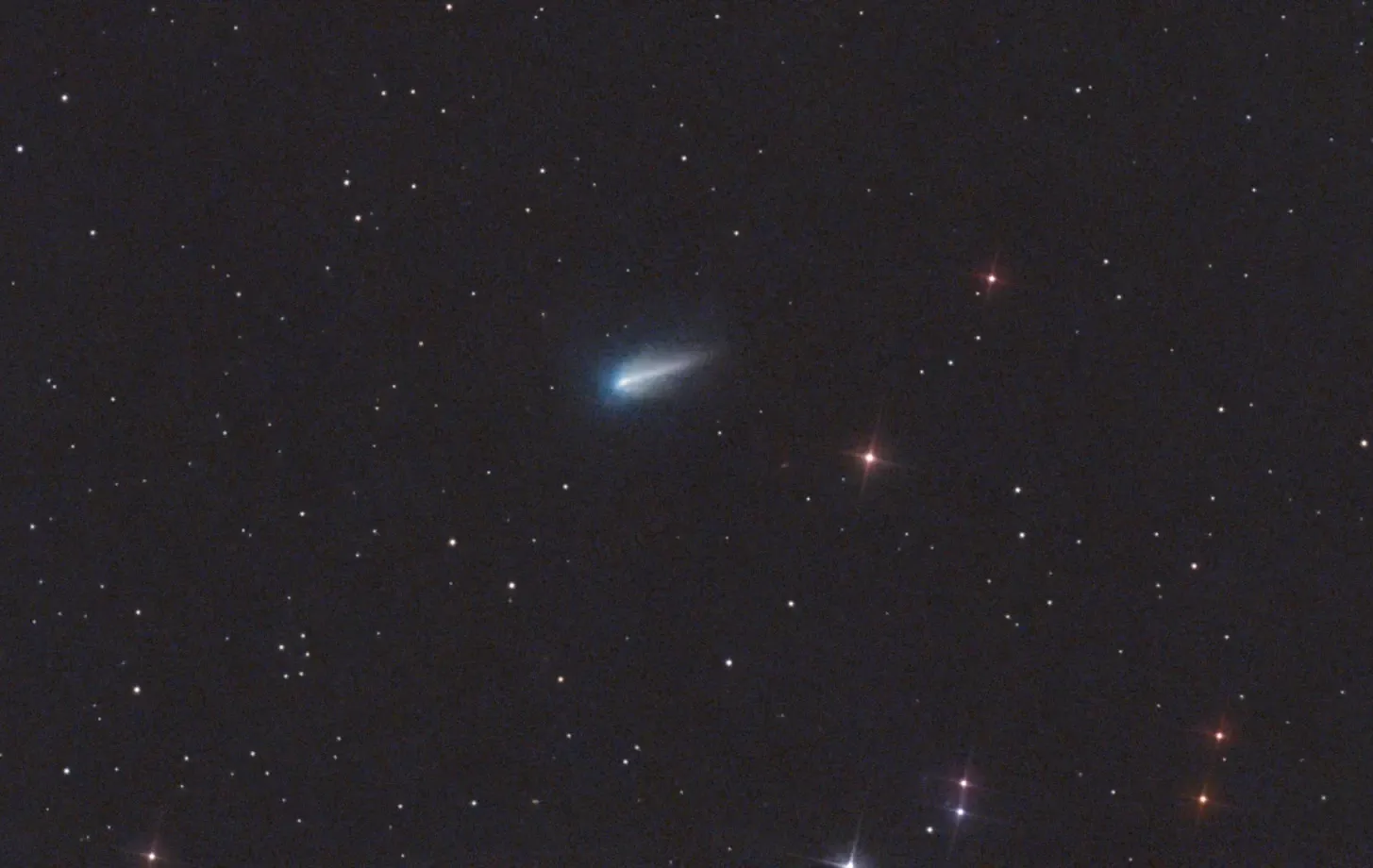
It’s quite distant so isn’t as good a target as C2025R3 back in April. But it’s higher in the sky.
Details:
Target: Comet 220P/McNaught
Equipment: Dwarf Mini, Astro filter, Alt-Az
Time: 2026-08-11 02:26..03:15
Integration: 37mins (150×15secs, +10 failures), gain 70
Conditions: Clear, Bortle 6
Processing: PhotoDesk equalisation, gamma, crop
And so to bed…
Triangulum Galaxy
August 8. Despite very poor conditions, here’s a first go at Messier 33, the Triangulum Galaxy:
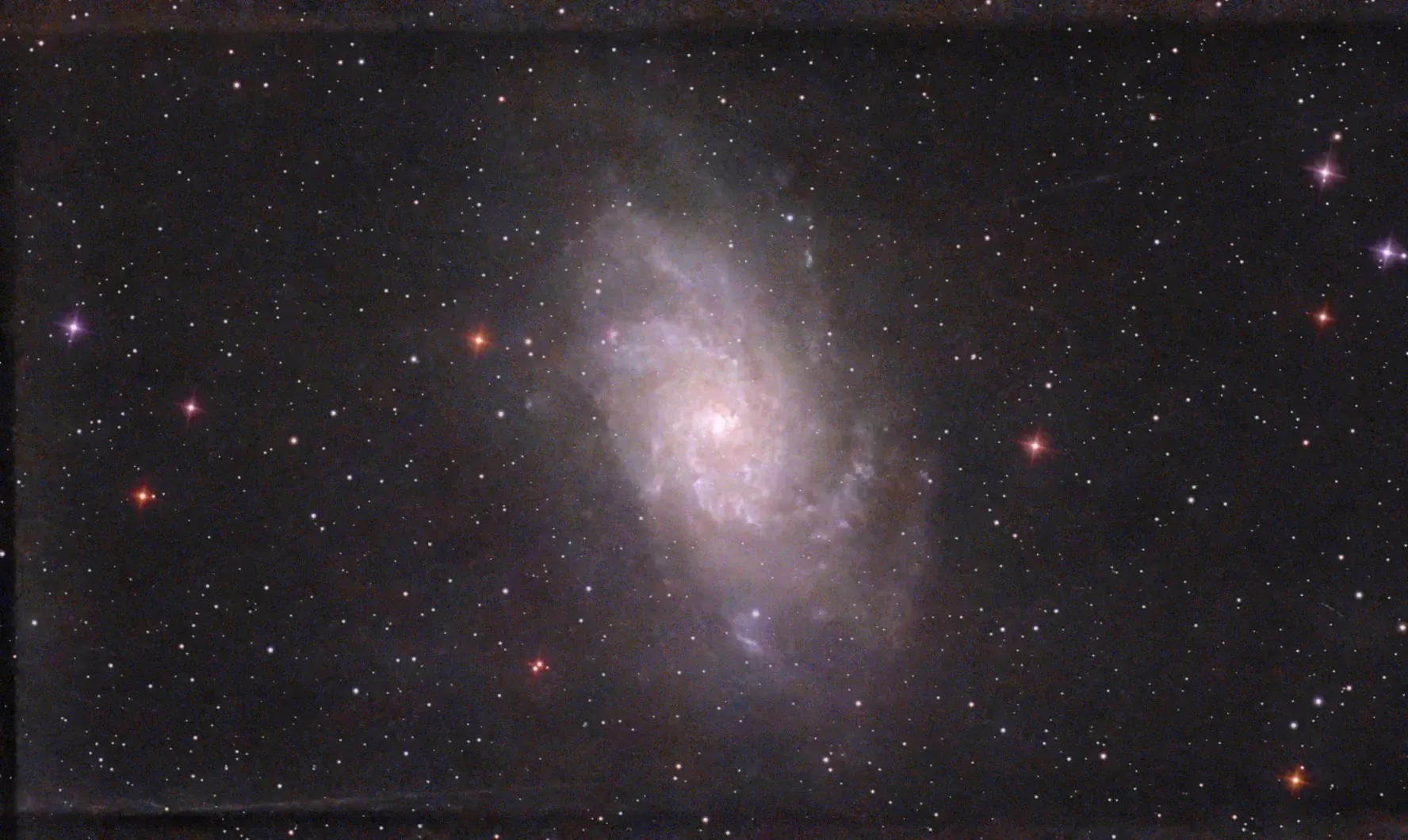
Clouds were constantly scudding across the sky and there was a lot of high haze, but there were enough gaps to let the Mini build an image; the edges of the image illustrate the problems. Using the Astro filter helps a lot with haze and thin cloud.
This galaxy in the Triangulum constellation is the third largest in the Local Group, behind Andromeda and our own. And despite the conditions, the pinkish colouration of the emission nebulae in the spiral arms is starting to become visible. So it’s a start.
Details:
Target: Triangulum Galaxy (M 33, NGC 598)
Equipment: Dwarf Mini, Astro filter, perfect EQ
Time: 2026-08-09 00:25..04:20
Integration: 3hrs 4mins (184×60secs, +28 failures), gain 70
Conditions: Poor (haze, clouds), Bortle 6
Processing: PhotoDesk equalisation, gamma
And so to bed…
Another Ghost, with Another Soul
August 7, and a clear night at last.
So here’s the Ghost Nebula IC 63 again. The previous attempt used the Duo-Band filter, but last night I used the Astro one. The last update to the Mini’s software allowed you to stack images with different filters, so this is the combination of both:
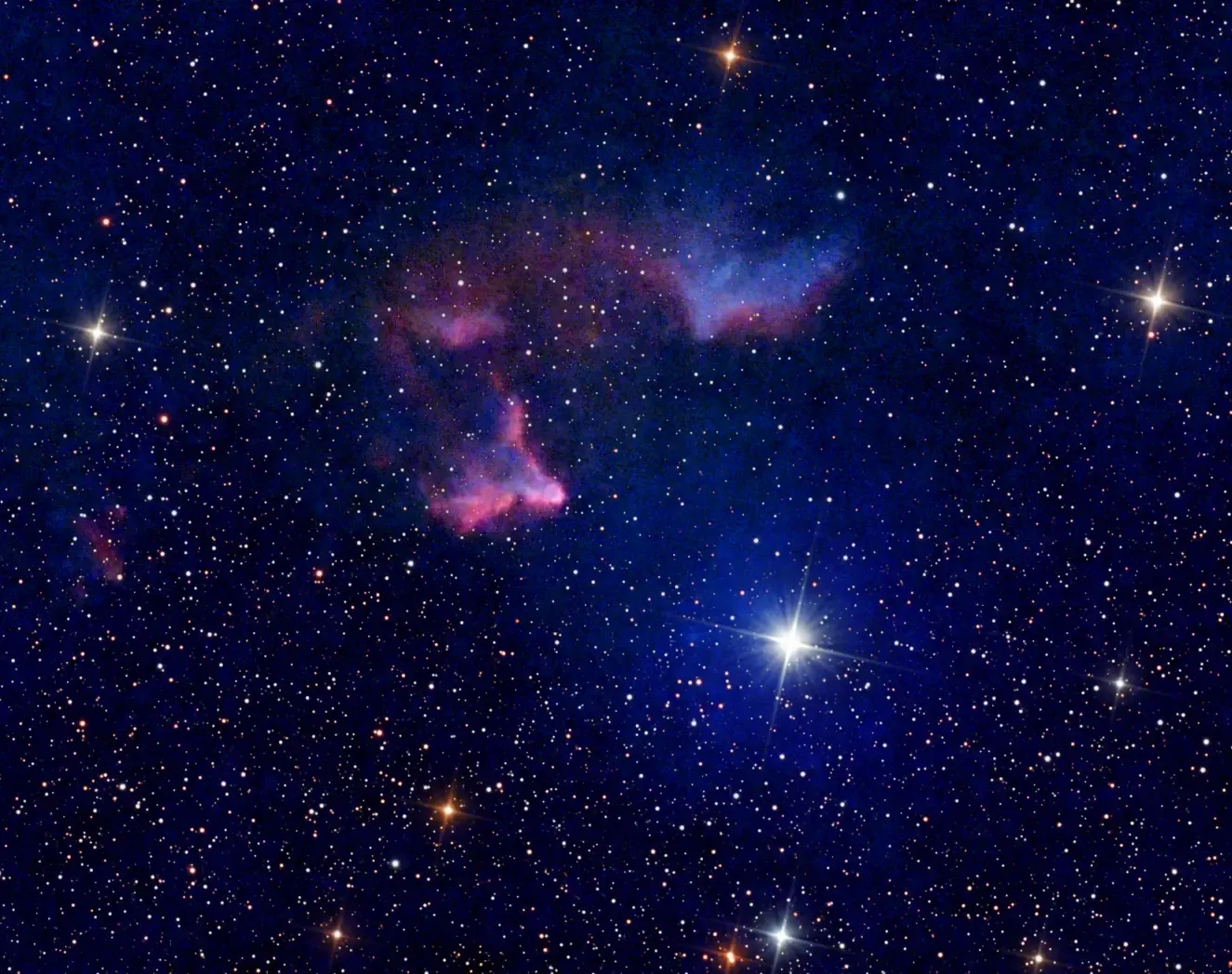
This has brought out the emission and reflection parts a bit better. But I’m still not happy with the processing.
Details:
Target: IC 63 (Ghost Nebula)
Equipment: Dwarf Mini, perfect EQ
Megastack:
1: Duo-Band filter
Time: 2026-07-30 22:47..01:28
Integration: 2hrs 19mins (139×60secs, +8 failures), gain 60
Conditions: Very clear, slight wind, Bortle 6
2: Astro filter
Time: 2026-08-07 22:22..01:28
Integration: 2hrs 35mins (155×60secs, +16 failures), gain 70
Conditions: Very clear, Bortle 6
Processing: PhotoDesk gamma, equalisation, crop
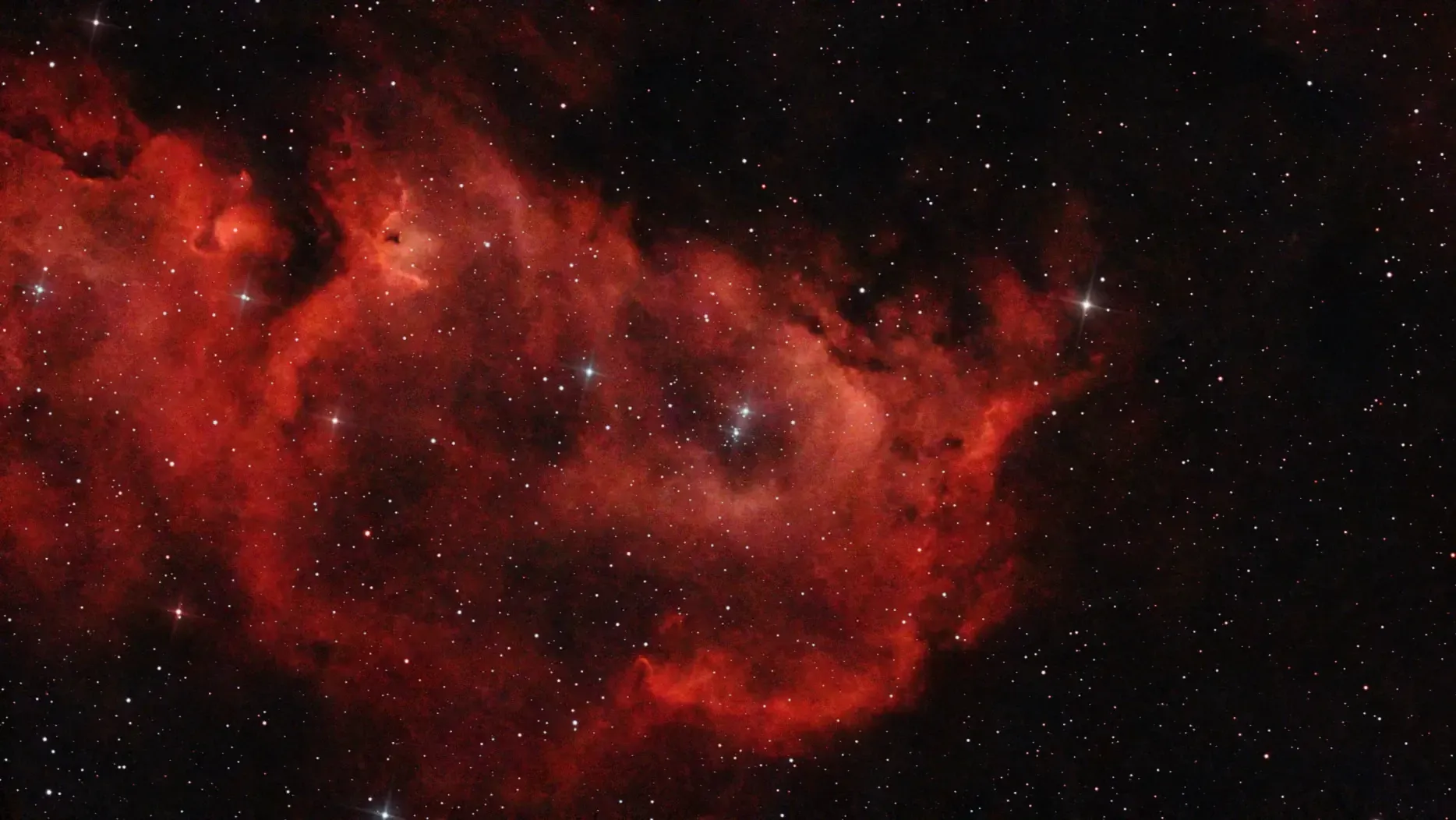
The previous attempt at the Soul Nebula was cut short by clouds, so I had another go and megastacked them:
Details:
Target: Soul Nebula (Westerhout 5, Sh-2 199, LBN 667)
Equipment: Dwarf Mini, Duo-Band filter, perfect EQ
Megastack:
1: Time: 2026-07-18 01:10..03:30
Integration: 1hr 24mins (84×60secs, +45 failures), gain 60
Conditions: Hazy, then cloudy, Bortle 6
2: Time: 2026-08-08 01:40..03:59
Integration: 2hrs 7mins (127×60secs, 0 failures), gain 60
Processing: PhotoDesk equalisation, gamma
And so to bed…